On Spectacles and Other Embarrasments

And when he had disarmed the rulers and the authorities, he made a public spectacle of them, triumphing over them in the cross. Colossians 2:15

Spectacles have an origin. They don’t occur in and of themselves. They are fruits and manifestations of much more primary occurrences. If we hold to the belief that our lives in this world are but shadows of the occurrences that take place in the spiritual realm, which we do, then it should come as no surprise that the spectacles in our lives are mere reflections of an ancient and eternal truth that has been told through the story of the serpent’s rise and fall.

Herein is the key. The rise preceded the fall. The rise was not ordained by God, but fueled by pride, and so it led to the fall – as promotions of the self always do. In its final conclusion, the rise became nothing but a public spectacle, a convulsion of sorts.

It was Paul who noted that the narrative was more than mere history. An overseer of the church, he noted, must not be a new convert, lest he becomes swelled up with pride and fall into the judgment of the Devil. The story is a parable and the message is clear: The one who promotes him or herself will become a spectacle for the world to see. Their rise will not lead to glory but to shame. John tells us in his revelation that the dragon was thrown down to earth. Knowing that his time was short he persecuted the woman. He wished the same spectacle on her that he had become, and so he has tempted her since she first set foot on the planet with the very temptation that he himself had been tempted with, desiring to involve as many as possible in the spectacle that he had become. The first woman became the first victim. Her yearning for greatness led to shame. Both she and her husband were made spectacles as a result of their desire to rise up and be like God, and after them a multitude followed in their footsteps.

It was Jesus Christ, the second man, who reversed the order. His fall preceded his rise. He became nothing, we read in Paul’s letter to the Philippians. Unlike Satan, Adam, Eve and every lost soul in the history of the universe, Christ did not see equality with God something to be grasped. He became nothing, and so God exalted him to the highest place. And herein we are given a second parable, and so since the dawn of time the people of God have been characterized by the fact that they are first a spectacle and then exalted.

The Death of Dualism

“Dere be two sides to de gospel,” said the old Negro preacher, “de beliebing side, and de behabing side.”

He was right: The gospel has a God side as well as a human side to it. And in case you hadn’t noticed, it is this very fact that has led to theologians wanting to throttle each other for centuries. Was Jesus God or man? Are we saved by divine election or by free choice? What is more important: Grace or works? Or, in the Negro preacher’s words: Beliebing or behabing?

An Age-Old Division

These are but some of the debates, and they all prove an interesting point: Like the ancient Gnostics, we have noticed that there is both a spiritual and a material element to life. But we struggle to work out the relationship between the two. We struggle to understand how they exist together, and, in our efforts to do so, we often embrace the one at the cost of the other.

Diagrammatically, the relationship between the spiritual and the material is oftentimes presented as follows:

According to our diagram, grace represents the spiritual, the higher, the heavenly, the invisible. Nature represents the material or fleshly, the lower, the earthly, the visible. This would put God above the line, and people below the line. The big question is: How do they fit together?

The Gnostics believed that they had found the answer: They reckoned that the lower storey of “nature” was very much like a prison. The spirit or soul of man was being held captive here, and what was needed was some form of “escape”. This escape could only take place by a denial of everything that was “natural” or fleshly. Celibacy, self-castigation and strict dietary rules are some examples of efforts to escape the lower storey of nature.

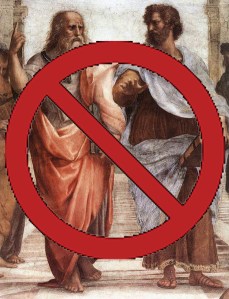
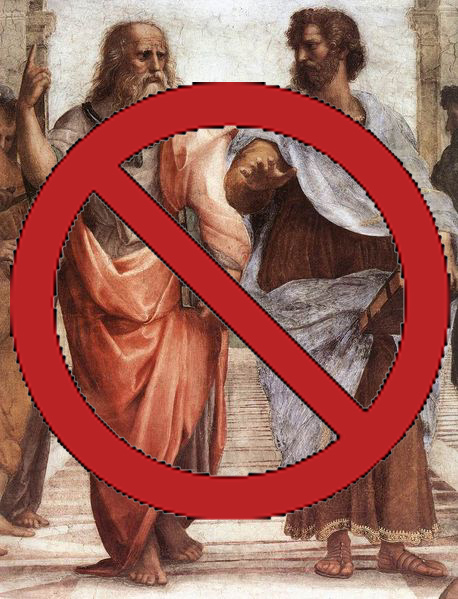
Had Plato lived in the second century, he might have sued the Gnostics for stealing his ideas. Plato was much concerned with the division between the upper and lower levels of life, and so the term “dualism” is narrowly associated with Platonic thought. Raphael’s famous painting The School of Athens is mostly interpreted as presenting the tension between the heavenly and the earthly dimensions: Plato and Aristotle are seen in the center of the picture, with Plato’s finger pointing up and Aristotle’s hand gesturing down. It has often been said that every great Greek philosopher can be seen in the picture. The challenge to understand the relationship between so-called “first causes” and its earthly manifestations was a common one at the time.

The Birth of Christian Dualism

Many years later, these ideas would infiltrate Christianity under the guise of monasticism. It was basically the same old Gnostic idea, heavily influenced by Platonic dualism, with a Christian whitewash over it. It was also a fulfillment of a chilling prophecy that Paul gave to Timothy long before:

Now the Spirit expressly says that in later times some will depart from the faith by devoting themselves to deceitful spirits and teachings of demons, through the insincerity of liars whose consciences are seared, who forbid marriage and require abstinence from foods that God created to be received with thanksgiving by those who believe and know the truth. For everything created by God is good, and nothing is to be rejected if it is received with thanksgiving, for it is made holy by the word of God and prayer. 1 Timothy 4:1-5

Along the same lines, Paul wrote to the Colossians:

Therefore let no one pass judgment on you in questions of food and drink, or with regard to a festival or a new moon or a Sabbath. These are a shadow of the things to come, but the substance belongs to Christ. Let no one disqualify you, insisting on asceticism and worship of angels, going on in detail about visions, puffed up without reason by his sensuous mind, and not holding fast to the Head, from whom the whole body, nourished and knit together through its joints and ligaments, grows with a growth that is from God. If with Christ you died to the elemental spirits of the world, why, as if you were still alive in the world, do you submit to regulations – “Do not handle, Do not taste, Do not touch” (referring to things that all perish as they are used)–according to human precepts and teachings? These have indeed an appearance of wisdom in promoting self-made religion and asceticism and severity to the body, but they are of no value in stopping the indulgence of the flesh. Colossians 16:23

Note that the effort to deny the lower storey of matter, through “severity of the body”, is accompanied by efforts to make manifest the higher spiritual storey, through visions and an obsession with angels.

A Stairway to Heaven

Christian dualism is what you get when you subscribe to a mystical and otherworldly view of spirituality (not in the Barthian but in the Platonic sense). It is rooted in the assumption that our salvation, according to this definition, has come in its fullness and that we can and should live on this planet as super-spiritual beings. Due to the fallenness of our environment, however, we are held prisoners, and thus we dedicate our lives to planning and implementing our escape. This we do by creating various spiritual compartments in our lives that allow us to act out our otherworldliness. We have done so over the centuries, from the early years of Monasticism to that which we call the “full-time ministry” today – the ultimate modern compartment of super-spirituality, and, as such, the object of envy for millions of Christians.

Some of us have crossed the threshold between matter and spirit, between worldliness and divinity, and we live our lives on a different plane.

Dualism and the New Covenant

Of course this is not what the Bible teaches. Christianity is an integrated lifestyle – being in the world, but not of the world. The Old Testament picture of compartmentalised religiosity has been done away with as a result of the dawning of a new, better covenant: A covenant where the Sabbath is no longer restricted to one day of the week, but where it becomes a lifestyle of rest due the finished work of Christ; a lifestyle where the ritual of sacrifice is no longer restricted to certain times and events, but where it becomes a permanent reality in heavenly places; a lifestyle where prayer is no longer something we do only at set times, but something we are admonished to do at all times; a lifestyle where our giving is no longer restricted to one tenth of our income, but to everything we own; a lifestyle where we no longer fast at certain times for certain purposes, but where fasting becomes a lifestyle of continuing sacrifice – where we become the sacrifices, as Paul puts it; a lifestyle were the ministry of the priesthood is no longer limited to a select few, but where each and every believer carries the title of priest; a lifestyle where the art of loving is no longer something we do only where we find those who qualify for our love, such as the image we find of the “neighbor” in the book of Leviticus, but something we do at all times to all people, such as the image we find of the neighbour in the parable of the good Samaritan and the Sermon on the Mount – where we do not look for a neighbour but we become the neighbour – living a life of love, as Paul instructed the Ephesians; and lastly, a lifestyle where we need not break into the holy of holies because our God is hiding there, but one of continuous fellowship with a God who is with us.

Compartmentalised spirituality has become the great enemy of the church, partly due to its extreme form of godliness and the religious pride it injects, and partly due the excuse it offers the rest of the spiritual plebs for just being the unspiritual creatures they are. The one side of the dualistic coin is legalism, the other side is worldliness – and these two have proven to be the greatest barriers to the life preached by Christ.

Dualists are people who do not realise that the call to discipleship is not a call to “doing” but a call to “becoming”. They do not see that God’s restorative action in our lives took place not because he introduced more or better ritual, but because he introduced the concept of the “new creature”, something unheard of in religion. And by introducing this concept the death of ritual was announced, for ritual no longer served any purpose. We now understand that its only purpose was that of a shadow, a symbol, pointing ahead to the good things that were coming.

The Great “There” Promised by Dualism

Dualism fuels the religious rat race, for it offers a pot of gold at the end of the rainbow, a higher state of being, an Archimedean point of absolute spirituality. Of course there is no unanimity as to exactly what this state consists of – the only unanimity amongst dualists being their collective discontentment with ordinary humdrum spirituality, and their subsequent desire and efforts to escape from it. And so we are always on our way somewhere, but we never arrive. We are always on a fast train to nowhere, which is why the trip feels great but the destination not. And whether we are chasing revivals, new waves of teaching, apostolic reformations, or whatever, like astronauts we always find ourselves coming back to earth after a season in space – only to begin planning for the next trip.

To use C.S. Lewis’ quip, “we live in the Shadowlands”, forever searching for that glorious spot of sunlight that so constantly evades us, forever searching for a stairway to heaven. Like the Samaritans, we believe our worship will be possible once we have identified the place to do it, and in the process we have created many mountains and even more Jerusalems. Feverishly active as both travelers and tour guides on these pilgrimages, Jesus’ crystal-clear teaching seems to have completely passed us by: “…a time is coming when you will worship the Father neither on this mountain nor in Jerusalem…a time is coming and has now come when the true worshipers will worship the Father in spirit and truth, for they are the kind of worshipers the Father seeks.”

Spiritual worship is possible worship, for it requires nothing but inner submission to God. It is the only fitting response to Jesus’ unorthodox and earth shattering statement “The kingdom of God is within you”, made to a group of religious separatists who were forever arguing the benefits of tradition, ritual and ceremony. By pointing inward, Jesus once for all settled the debate as to where God’s seat is to be found. An inner kingdom demands an inner response, an inner journey, and an inner kingdom places God within reach of all people. We no longer need to go to the mountain, the mountain has come to us. We are still pilgrims, yes, but our pilgrimage is a spiritual one.

Like the foolish Galatians, we have been bewitched. We who started of with the Spirit have halted in the flesh. Unwilling to accept that there is such a thing as a free meal, we have stubbornly refused to live by manna alone, and instead have slaved away at erecting a golden calf.

What Actually Happened on the Day of Pentecost

As a young Christian, eighteen at the time, I joined a Pentecostal denomination, and it took me nearly another eighteen years to find out what the day of Pentecost was all about. Strange as this may seem, it makes perfect sense when I think about it in hindsight. For many years I had the notion that the Spirit of God was a vague, impersonal, disembodied vapour who did little more than “energise” people. Certainly no-one ever taught me to believe this in so many words, yet this is what I perceived. In retrospect, it is clear that these beliefs came about as a result of the continual “search” for the Spirit that I observed in my denomination – as if He had disappeared. Phrases and prayers like “Come, Holy Spirit”, “I sense the Spirit of God in this place” and “Allow the Spirit to touch you” all contributed to my belief that the Spirit was far away and hard to find, yet that He appeared at times out of the blue, like a distant uncle popping in for a surprise visit.

Many years later I realised that the Spirit of God is not a force, nor an entity apart from God, but in fact God himself. And this changed my perception of Pentecost. Rather than an outpouring of raw power that had to be repeated over and over again, Pentecost became the day that the God of the heavens came to visit, and stayed. God was finally with us. The Spirit was no longer restricted to the holy of holies, but now made his dwelling with men and women. In order to become spiritual worshipers, the Spirit was needed, and it was on this glorious day that the Spirit came. It was not the beginning of a new era of successive visits and outpourings, but the birth of spiritual worship – a continuous relationship with the God who is with us.

And, as you would guess, it was the day that dualism died.
Catching the Wind

Peter said to Jesus, “Rabbi, it is good for us to be here. Let us put up three shelters – one for you, one for Moses and one for Elijah.” Mark 9:5

Peter’s awkward suggestion to put up three shelters on the mount of transfiguration presents us with a striking metaphor of our human tendency to try and capture the glory of God. It teaches us that God not only reveals himself to us in extraordinary ways at times, but also that we find it exceedingly difficult to deal with such revelations.

The history of the Christian church contains a number of remarkable and exceptional accounts of God’s intervention in human lives and churches. More than one supernatural incident has been reported by eye witnesses of the great revivals of previous centuries, and also by biographers of John Wesley, Andrew Murray and others.

However, church history also records that for every transfiguration a cluster of shelters is left behind. When the glory departs the shelters remain as hollow shrines – grim testimonies of our doomed efforts to prolong divine visitations, or even fabricate them.

These shelters come in many shapes and sizes, and usually differ from denomination to denomination. What they have in common is the underlying assumption that we are responsible to house the Spirit of God somehow, to make him stay with us, to possess and own him. We can try and do so by containing God in our creeds, in the imagery and statues of our buildings, or by scheduling healings and miracles as though God’s power is a magic at our disposal.

Let us remind ourselves that Jesus once likened the work of the Spirit to the wind, blowing when and where it wishes. We can capture God’s sovereign Spirit no more than we can catch the wind.

The Cult of Arrivalism

There is something wickedly satisfying about arriving first in life. This I learned at a tender age after my first success in beating my older brother to the kitchen table in our house in Namibia. Our lunchtime races down the long passage had become somewhat of a ritual, and, being the smallest, I was usually the last one to arrive. But when success did come it came sweetly. After all the thrashings, I enjoyed his defeat even more than my victory.

This is why I call it wickedly satisfying, for joy derived from another’s misfortune is wicked indeed. The Germans speak of “Schadenfreude” (leedvermaak in Afrikaans), that is, that warped sense of relief we experience when something bad happens to others instead of us. It explains why humans enjoy gossip and are morbidly fascinated with vehicle accident scenes, and it reveals something of the universal human drive to end up on top of the heap, to always win, to die with the most toys (See Ecclesiastes 4:4). The rat race is indeed an apt description of life on planet earth.

Ego-death a Non-negotiable

Many prophets and sages have warned for millennia against running this race, and they have done so in the names of many gods. Take Buddhism, for instance. The Buddhist authorities in the Himalayan Kingdom of Bhutan have banned advertising. If you remove the source of envy you also remove unhappy and resentful feelings about others’ possessions, they say. There are many similar examples.

The gospel of Jesus Christ, however, has a completely different approach to the matter. Instead of warning us against running the rat race, it tells us that we are rats. We are, therefore, perfectly consistent when we behave in the crazy ways we do. It is not our behavior that constitutes the problem, it is our identity. Hence the New Testament’s one and only prescription: The annihilation (read crucifixion) of the competitive rat.

Without this event, we can call it ego-death, any effort at Christianity is as sensible as attempting to climb Everest by staying at home. It simply cannot be done. The cross is no different to the guillotine, the noose or the electric chair. It is an instrument of death and serves the explicit purpose of executing the criminal. What a silver bullet and wooden stake are to a vampire, the cross is to the ego. The funeral of baptism is the funeral of self, and so 2 Corinthians 5:17’s “new creation”, resurrected in the image and the likeness of Christ, is a creation that seeks not to win but to serve, for this is what Christ came to do. It was Adam and Eve, under the inspiration of the serpent, who thought that equality with God was something to be grasped, not Christ (See Genesis 3:5 and Philippians 2:6).

A Religious Masquerade

Egos, of course, hide well, and they hide best under cloaks of righteousness, which is why we so constantly run into them in churches. In the Bible religious self exaltation is personified by the sect of the Pharisees: “They do all their deeds to be seen by others… they make their phylacteries broad and their fringes long, and they love the place of honor at feasts and the best seats in the synagogues, and greetings in the marketplaces and being called rabbi by others.” Their dress code, behaviour in the religious assemblies, status and titles all conspire to elevate them above the masses, giving them the bizarre privilege of fusing the religious pilgrimage with the ego-trip, impressing God and people simultaneously, obtaining heaven with earth still in their pockets.

Winning means arriving first, as my early races down the passage taught me. To win one must have arrived, and winning religiously implies having arrived religiously. For clerical supremacy to survive some sort of arrival is required, and, as it happens in churches, a fitting doctrine is needed to prove and clarify the arrival.

A doctrine of arrival, put very simply, is a theologically constructed idea which proposes some final insight, experience or realisation of promise. It distinguishes the one who has arrived from those who are still on their way. It also offers a circumvention of the painfully humbling business of believing, hoping and waiting. Proud people do not wait well, which explains why God employs time so successfully in humbling his servants. Forcing arrival by fabricating a destination is humanity’s attempt to appear victorious and to bypass the discomfort caused by the impatience of the ego.

The Error of Realised Eschatology

There is no heresy as deceitful as the one which offers a shortcut to the Promised Land. Such impatience led to Adam’s sin, to Esau forfeiting his birthright, to the Israelites constructing a golden calf and to the Prodigal leaving the family home. Every time the underlying philosophy is the same: We want it all. We want it now

Since the time of Hymenaeus and Philetus, who taught “that the resurrection has already happened”, doctrines of arrival have littered the ecclesiastical landscape. Theologians speak of “realised eschatology”, that is, the erroneous and dangerous view that the blessings linked to the resurrection of the saints, the Lord’s return, the visible and final coming of the Kingdom and the restoration of all things are to be appropriated somehow in this world and age.

There are many modern day examples of this age-old heresy, for instance prosperity theology (the restoration of our finances and possessions), extreme teachings on healing (our bodies and health have been restored), obsession with signs and wonders (natural laws have been made subject to us), the conviction that doctrinal perfection is possible (we understand perfectly), elitist churches who believe that they have a perfect understanding and practice of “fellowship” (we love and meet perfectly), post-millennial Reconstructionism or “Kingdom Now” theology (we have the perfect political system) and the belief in sinless perfection (we are perfectly holy).

All of these, of course, are just different and novel ways of proclaiming “we have arrived”.

The Biblical Doctrine of Waiting

It was David who said “Wait for the LORD; be strong, and let your heart take courage; wait for the LORD!” This principle runs like a golden thread throughout Scripture. Abraham had to wait for the promise of a son to be fulfilled. Moses had to wait 40 years in the wilderness before God called him, and then another 40 years before he was afforded a glimpse of the Promised Land. The disciples had to wait for the promised Holy Spirit, and in the letter to the Romans we read that we “groan inwardly as we wait eagerly for adoption as sons, the redemption of our bodies.”

The Kingdom has come in part but not fully. We haven’t arrived yet, and the pain of the planet is one of God’s most efficient tools to remind us of this and to build our faith. The heroes of Hebrews 11 were all looking ahead to a heavenly country. They were not perfectly healed, prosperous, organised or, if you look closely, sinless. Their ‘perfection’ beckoned from a heavenly country.

The ironic thing is: To the degree that we want to drag heaven down here we cease to find it in our hearts, we cease to live by faith, in other words. Perfectionism in its many guises is nothing but veiled materialism. It is an insistence to make the intangible tangible, a refusal to live by faith.

The answer to all of these is quite simple:

For I consider that the sufferings of this present time are not worth comparing with the glory that is to be revealed to us. For the creation waits with eager longing for the revealing of the sons of God. For the creation was subjected to futility, not willingly, but because of him who subjected it, in hope that the creation itself will be set free from its bondage to decay and obtain the freedom of the glory of the children of God. For we know that the whole creation has been groaning together in the pains of childbirth until now. And not only the creation, but we ourselves, who have the firstfruits of the Spirit, groan inwardly as we wait eagerly for adoption as sons, the redemption of our bodies. For in this hope we were saved. Now hope that is seen is not hope. For who hopes for what he sees? But if we hope for what we do not see, we wait for it with patience. (Romans 8:18 – 25)

Christianity is a waiting religion. When we wonder why this is so, we are reminded by Scripture that we are “saved in hope”, and that “if we hope for what we do not see, we wait for it with patience.” Ultimately all waiting experiences are intended by God as exercises to strengthen us for the great wait: The day of his coming. Through them we are taught and reminded that the gratification of Christianity is not instant but deferred. Through them we learn to live by faith, not by sight.

(This article has also been published in the Auksano magazine)