When Your Aim Is Wrong

The aim of our charge is love that issues from a pure heart. 1 Timothy 1:5

Is it just me, or have we all been duped?

Eight years ago, I stumbled onto something that made me question my entire so-called “Protestant heritage”. I am not quite ready to venture into that story here (I have been re-reading and re-highlighting my Bible since then, like an infant who has discovered a new toy, and I’m still stuck in the novelty of it all), but one thing I can share is the experience of being a Christian outside the warm fuzziness of a global identity with its own superheroes and folktales of historical conquests. These conquests, so the stories go, have kept the household of God firmly from sliding into the hellish cauldron of heresy that is the unfortunate and inevitable fate of those who dare set foot outside the community walls – walls carefully and lovingly constructed by the family fathers and ideological forebears whose insights are the lights of the city behind them.

It’s a rather desolate (albeit breathtaking) landscape out here, I must admit, and the journey is solitary at times. Most pilgrims who have walked these roads have disappeared through other doors. Doors with their own walls. Walls enclosing their own communities. Communities circulating their own folktales. Folktales with their own heroes. Heroes carrying their own lights.

But there are pleasant surprises here. Whilst the paths of this landscape are narrow, they are void of the abominable heresies warned against behind those walls. The pitfalls are plentiful, that is true, but you will steer clear of them as long as you remain on the trails.

Also, the pilgrims one encounters here are remarkably easy to communicate with, as if the exquisite nature of this place has brought them to a blissful state of rest that has banished all need for religious propaganda or its insignia. Conversations are not umpired by ecclesiastical allegiances, credal checkboxes or big-name dropping.

All of this has made me think of something: What if we have misunderstood sin?

Yes, we have heard ad nauseam that sin is to “miss the mark”. But which mark? What if we, in our neurotic efforts to hit the mark and escape the fires of hell, have been aiming at the wrong target?

What if, and this is going to sound crazy, we find ourselves one day arriving at another door – one leading to the wedding feast of the Lamb – with a smile of expectancy on our faces and a lifetime of testimonies of hitting the bullseye again and again and again, only to hear a single sentence uttered by the guardian of that door:

“You have not loved adequately.”

“Huh? What the flowers? What’s love got to do with it?”

“Everything.”

“I’m sorry. I am justified by grace through faith.”

“You have not loved adequately.”

“Wait, this is annoying. I am saved by grace. I am a Protestant!”

“A what?”

“A Protestant! I protest against a works-based gospel!”

“Why would you want to do that?”

“Because works cannot save you. Ephesians 2, verses 8 and 9: ‘For by grace you have been saved through faith. And this is not your own doing; it is the gift of God, not a result of works, so that no one may boast!'”

“Have you read verse 10?”

“Verse 10?”

“Yes. ‘For we are his workmanship, created in Christ Jesus for good works, which God prepared beforehand, that we should walk in them.'”

“Oh.”

“If you wanted to spend your life protesting, you should have protested against a works-free gospel, not a works-based gospel. Have you not read James?”

“I am a follower of Luther, and Luther did not like James. He called it a straw letter, because it suggests that we have to do works to be saved.”

“Luther was wrong. He missed the meaning of James’ letter.”

“Which is?”

“You have not loved adequately.”

“Oh no, here we go again. Are we speaking about the same James, the one who sounds like a legalist?”

“A what?”

“A legalist.”

“What is that?”

“One who keeps the law to get saved.”

“The James I speak about did not do that. He got saved to keep the law.”

“Ah. You see! He’s a legalist. Whether he kept the law to get saved or got saved to keep the law, he was still under the law. In any case, what has keeping the law got to do with loving adequately?”

“Everything.”

“I don’t understand.”

“No, you don’t. James does not abolish the law. He speaks about the law in its fulfilled state. That is why he calls it the perfect law, the law of liberty, and the royal law, namely to love your neighbour as yourself. Breaking this law means your religion is worthless and your faith is no different from the faith of demons. The works James refers to are works of love.”

“Uhm, can’t we rather speak about Paul and his message of grace?”

“We can. Where would you like to start?”

“Romans, please.”

“Do you think Romans differ from James?”

“Yes, absolutely.”

“Yet Romans’ main point is exactly the same as James’.”

“No!”

“Yes. You have not loved adequately.”

“Where does it say that?”

“All over, but especially in Chapter 13. The entire law is summed up in a single commandment, “You shall love your neighbour as yourself,” which means the one who loves another has fulfilled the law. Romans’ charge that we are all lawbreakers is just another way of saying we have not loved adequately. To be freed from sin in Romans is to be freed from the inability to love. To not love is to remain in sin.”

“Let’s rather go to Corinthians.”

“Sure. That’s where we read that even if I have all faith and have not love, I am nothing. Correct?”

“Let’s skip Corinthians and go to Galatians.”

“Ah, the calling to freedom in order to serve one another through love and so fulfill the whole law as expressed through a single word: “You shall love your neighbour as yourself.”

“Uhm… Ephesians?”

“The letter that links Christ dwelling in our hearts through faith with being rooted and grounded in love?”

“Let’s forget about James and Paul and rather go to Jesus. He was all about grace and acceptance, wasn’t he?”

“The gospels? Would you like to start with Matthew, where we read that the Law and the Prophets can be summarised in the command to do unto others as you would have them do unto you, and that those who did not do this will be called lawless and told to depart from Christ even if they prophesied and drove out demons and did many mighty works in his name? They did not love adequately, you see. Or should we start with the separation of the sheep and the goats on the Day of Judgment, where we see that the sheep are distinguished from the goats by their care for the hungry, the naked, the sick and those in prison? The goats… they did not love adequately. What about Jesus saying that all the Law and the Prophets hang on the two commandments to love God with all your heart, mind, soul and strength, and your neighbour as yourself? Or perhaps you want to go to Mark, where we read that to love one’s neighbour as oneself is much more than all whole burnt offerings and sacrifices? Or Luke, who spoke about a Samaritan who understood the aim of the law better than a priest and Levite combined. He loved adequately, they did not. Or John, where Jesus introduced a new commandment to his disciples, namely to love one another as he has loved them. Maybe Acts, where Jesus is quoted as having said it is more blessed to give than to receive?”

“Stop, please. I thought people get saved by grace.”

“They do, but grace that does not enter your heart and flow from it as love is grace that cannot save. You shall know true grace by its fruit, and its fruit is works of love. If grace is powerless to transform you, it is powerless to save you from death. Inadequate love simply means never having been saved to begin with.

“Why did no one tell me this?”

“Where you come from, they spoke so much about the forgiveness of sins that they had no time left to speak about what sin really is. They hit the mark, but the target… I’m sorry. It was the wrong one.”


Where do the ducks go?

What do you do when you stumble upon a truth that is too big for theology?

The question reminds me of another one: Where do the ducks go when the lagoon in Central Park freezes over?

Recognize the words? It’s from Salinger’s famous The Cather in the Rye (spoiler alert), and it is so subtly asked in the novel that the careless reader is bound to gloss over it. It also remains unanswered, which is significant. There is an idiotic attempt at a response by a nameless cab driver, but that does not count. If anything, his answer adds to the mystery.

Why does the question matter? Because it encapsulates the aimlessness of the protagonist Holden Caulfield’s wanderings. Everything remains open-ended, it seems. His efforts at meaning-making and finding answers lead him nowhere. Ultimately, he fails to discover where one goes when your circumstances become unbearable. That’s the point.

No one knows, it seems. Least of all the grown-ups.

So what does Holden do? This is where the beauty comes in, and, in my view, the single element that has catapulted the book to the top lines of must-read lists for decades. Salinger manages to say more through a single image – a catcher in the rye – than libraries of philosophy have done for centuries.

Anyway, I keep picturing all these little kids playing some game in this big field of rye and all. Thousands of little kids, and nobody’s around – nobody big, I mean – except me. And I’m standing on the edge of some crazy cliff. What I have to do, I have to catch everybody if they start to go over the cliff – I mean if they’re running and they don’t look where they’re going I have to come out from somewhere and catch them. That’s all I do all day. I’d just be the catcher in the rye and all. I know it’s crazy, but that’s the only thing I’d really like to be.

When your life becomes unbearable, and you wish you could spread your wings and fly away from it all, but you cannot – because there simply is nowhere to go – then there is a single sensible thing left to do: Help others not to fall into the abyss that your life has become.

Yes, I know. Not everyone interprets the book in this way; as though there is some moral compass to discover in it. The book has little to do with Christianity, and no one can be exactly sure what the famously elusive Salinger was thinking when he wrote the words above. Yet, somehow he tapped into the collective psyche of the human race by confronting the aimlessness of mortal human existence with a viable and practical alternative; to give up the quest and substitute it with a life of selfless service.

If you get this, you can skip reading the book. You can skip the profanities and references to sex (although moderate by today’s standards). It’s not a book Christians have generally felt comfortable reading or recommending. But we can certainly note that Salinger does a brilliant job of using a single unanswered question as a premise for painting a beautiful scene of a life dedicated to the well-being of others and, in the process, a life that becomes progressively oblivious to its own pain.

This life-out-of-death motif is central to Christianity. It underlies the sacrificial theme of both testaments. It illustrates what Jesus meant when he said that if you seek to find your life you will lose it, but if you lose your life you will find it. Here’s the connection.

To be clear, we do not serve to escape or forget our pain. We do so because Christ is our life and it is his divine nature to love and serve. The catcher-analogy breaks down at a point. Yet, at a practical level, to be other-centered is a great way to forget about yourself and your own misery. No rational person would deny this.

Which brings me back to my own question above: What do you do when you stumble upon a truth that is too big for theology?

Ironically, as I am writing, my friend Siju from India posted in the comments section of last week’s blog-post. His words so perfectly and serendipitously describe where I am heading with the question above that I will borrow them (Thanks Siju!):

Bible study done by the natural mind happens in the realm of the flesh/natural which consists of “IMAGINATIONS, ARGUMENTS, PROPOSITIONS & CONCLUSIONS” which do not have the SUBSTANCE of LIVING BREAD that gives/maintains life. And such bible study (or ministry ) inevitably ends up in debates such as “Calvinism vs Arminianism”. It is like a hungry man given a fantastic menu in the restaurant, it tantalizes him but he is still hungry! And he does a deeper study about the dishes that he thinks will satisfy him and finds out their recipes and is thrilled for a time because of the discovery but faints because he has yet not got the meal!!! He then slanders this hotel and goes to another hotel and repeats the same thing but still does not receive the meal that can sustain/maintain his life with “vitality to perform daily tasks “, “pleasure satisfy his longings”, and “comfort in times of troubles”. New Covenant learning and ministry is NOT “learning and transferring concepts” but the broken and hungry being fed with “Living Bread by the Father” ( https://biblehub.com/matthew/5-6.htm ) and due to a “love overflow” ( https://biblehub.com/psalms/23-5.htm ) the same person is able to distribute “Living Bread in brokenness provided by Christ from the Father”.

The “study of the dishes”… What a powerful way to describe the practice of theology apart from partaking of Christ as the living bread from heaven!

The point is that there is no answer that can satisfy the yearning of the dying soul (Hence the Catcher-analogy above). The life that God alone can give is not an ideological construct and can never be reduced to one, which also happens to be the main point of last week’s post on Ravi Zacharias.

In the garden, God became an idea – an intellectual concept – the moment the humans sank their teeth into the forbidden fruit. By opting for an alternative source of life, namely the knowledge of good and evil, humanity subjected their notions of God to that source. And so God (god?) became a recruit into the thought-world of humans instead of the Creator outside of it.

In the process, God-talk became an intellectual and speculative thing, on the same par as Siju’s menus served in the different hotels apart from any real food that possesses the power to still appetites.

The idea of God as our life is too big for theology. In fact, it is not worthy of the designation “idea”. It is too real. Too incarnate. Too experiential. Too accessible. Too inviting. Too irresistible for the hungry and thirsty.

And the charge, that we will all lose our mental faculties and instantaneously become heretics if we dare conceive of life as something to partake of instead of reduce to a creed (menu?) of our choice, is too outrageous to be dignified by a response. As discussed elsewhere, the Biblical idea of heresy has to do with the act of choosing opinions and causing divisions in the process.

So where does one go?

You exchange the quest for a new lifestyle. You give it up. You walk away. You leave it all behind. You become like Salinger’s catcher in the rye. You become like Siju’s feasters at the banquet of living bread.

In short, you begin to conceive of Christ as your life, and his doctrine as a moment-by-moment adventure of impartation and response that will constitute a type of learning that can only be described as the school of Christ. You will soon find that not only your God-awareness but your other-awareness will increase with leaps and bounds.

This does not exclude study or discussion or deliberation. Rather, it provides the groundwork for it. Some of us have found that we cannot stop talking after we’d walked away.

There are great discussions in the rye, believe me. But they are wholly different to the depressing ones we had before we packed our bags.

Who is the man in Romans 7?

Scream Edvard MunchRomans 7 may very well be the most misunderstood chapter in the Bible. It is here where we read the following words:

For I do not understand my own actions. For I do not do what I want, but I do the very thing I hate … For I know that nothing good dwells in me, that is, in my flesh. For I have the desire to do what is right, but not the ability to carry it out. For I do not do the good I want, but the evil I do not want is what I keep on doing.Now if I do what I do not want, it is no longer I who do it, but sin that dwells within me. Romans 7:15-20

Someone over at Quora asked me a while ago to explain the meaning of these verses. I know it is an issue for many Christians, so here is my answer.

I found it quite befuddling that the majority of responses to your question (by far) suggest that Romans 7:15–25 is about the “two natures” that battle within a Christian. This is in fact not the case, and it is evident from a few observations:

  1. Paul’s references in Romans 7, “I agree with the Law” (verse 16) and “I delight in the Law” (verse 22) occur nowhere else in the New Testament, and are irreconcilable with his statement that we have been “released from the Law” (verse 6) and that we have “died to the Law” (verse 4). Clearly the man of Romans 7 finds his moral guidance in the “old way of the written code” and not in “the new way of the Spirit” (verse 6). Similarly, his statement in verse 18, “I have the desire to do what is right,” contradicts his confession as a regenerate man in Philippians 3, namely that his main desire is no longer to do right according to the Law’s prescription (Phil. 3:9), but to “know Christ” (Phil. 3:10).
  2. The use of the present tense in the passage does not necessarily mean that Paul is speaking about a present experience. As some Bible commentators have pointed out, the tense that Paul is using here can be described as the “dramatic present.” (See, for instance, Martyn Lloyd-Jones, Romans: Exposition of Chapter 7:1-8:4, The Law: Its Function and Limits, Guildford and London: The Banner of Truth Trust, 1973, p184.) This means that Paul is using the same type of language as a man describing an accident scene that he had witnessed days before: “Here I am, standing on the pavement, ready to cross the road. The next moment I see this car. It jumps the red light and collides with a truck…” This person is clearly not speaking about his present experience, but is describing a past experience in the way that he experienced it while it was taking place. Thus, he is transporting his listener to the event for dramatic effect.
  3. In line with the above, readers regularly miss the fact that Romans 7’s own testimony, found in its opening verses, tells us how the chapter should be interpreted. Note verse 5: “For while we were living in the flesh, our sinful passions, aroused by the law, were at work in our members to bear fruit for death.” Paul is using the past tense (while we were living in the flesh) to describe a life that once was (sinful passions, aroused by the law, that bore fruit for death). As you will see, the rest of Romans 7 is about the experience of sinful passions that are aroused by the Law, and this includes Paul’s words about being unable to do the things that he wants to do! Thus, it is an account of a past experience, namely a life lived in the flesh void of the Spirit of God.
  4. The struggle of the man in Romans 7 is not with the Law in general, but with one single commandment, namely the prohibition to “covet” or “desire” (verses 7 and 8). The man in Romans 7 says that it was this commandment that enabled him to know sin, for it produced in him “all kinds of covetousness.” Thus, without it he simply would not have known sin for the powerful force that it is.
  5. The prohibition to “covet” is found in the tenth commandment of the Decalogue, and represents the sin of the heart as opposed to the misdeeds of the body. As I explained elsewhere: While the first nine commandments prohibit certain actions, the tenth commandment prohibits the intention that precedes those actions. Note that the seventh commandment tells a person not to “commit adultery,” but that the tenth commandment tells the person not to “covet your neighbor’s wife.” Also note that the eighth commandment tells a person not to “steal,” but that the tenth commandment tells the person not to “covet your neighbor’s ox, or his donkey, or anything that is your neighbour’s.” Clearly we break the tenth commandment every single time before we break any one of the other nine. And the reason is clear: We first desire to do something before we go ahead and do it. Put differently, we first do it in our hearts before we do it in our deeds.
  6. Romans starts off in Chapter 1 with a discussion of the entrance of sin into the world, and explains that it took place when God “handed us over to covetousness/desire” as a just retribution for having rejected his revelation towards us. This desire underlies the entire list of external “sins” that are listed in Chapter 1, and is “irresistible” due to the fact that God handed us over to it. Romans 7 tells us that the Law was given not only as a restraint against committing “sins” (plural), but also as an instrument to reveal the unconquerable power of “sin” (singular) within us, so as to make us look away from ourselves to a Saviour. Romans 7 can never be understood if it is not seen as a response to the problem of Romans 1!
  7. The pattern of desire underlying sins is confirmed by the Genesis account of the fall of humanity: The woman “saw that the tree was good for food, and that it was a delight to the eyes, and that the tree was to be desired to make one wise” (Genesis 3:6). The desire then overcame her and she ate the fruit.
  8. Similarly, James tells us that “each person is tempted when he is lured and enticed by his own desire. Then desire when it has conceived gives birth to sin, and sin when it is fully grown brings forth death.” (James 1:14-15)
  9. Peter and Paul independently identified desire as the single force that has corrupted humans and causes them to behave in the ways that they do:…he has granted to us his precious and very great promises, so that through them you may become partakers of the divine nature, having escaped from the corruption that is in the world because of sinful desire (2 Peter 1:4)…to put off your old self, which belongs to your former manner of life and is corrupt through deceitful desires. (Ephesians 4:22)
  10. Paul’s ultimate answer to the problem of irresistible desire is found in Galatians 5:24, and is there represented as the mark of the regenerate Christian: And those who belong to Christ Jesus have crucified the flesh with its passions and desires.
  11. The message of Romans 7 is that the spiritually astute Rabbi Saul of Tarsus was no exception to the rule above. While he could keep himself from doing any deed that was prohibited by the Law, he could not suppress the inclination of his heart that yearned to do them! The tenth commandment tells us that God is concerned with more than an outward allegiance to his Law. What he wants is an inward desire to please him. We should stop sinning not because we have to, but because we want to. And the only way in which that can happen is if we have a change of heart. Put differently: To keep the first nine commandments, one merely needs a measure of determination and will power. To keep the tenth, one needs a heart-circumcision, namely the crucifixion of the flesh as pointed out in “9” above. In this way the “Law is our schoolmaster to Christ.”
  12. To be regenerated is to experience a change of desire, and to identify Jesus Christ as the bread and water that alone can satisfy the appetites of the heart. It is to be enabled to “love the Lord your God with all your heart and all your mind and all your strength.” When this happens, the underlying motive for treating others unjustly disappears, for they are no longer regarded as potential sources for one’s well-being. One is then regulated from within, and no longer requires the Law as a restraint. In this way the “righteous requirement of the Law is fulfilled,” as stated in the opening verses of Chapter 8. Chapter 13 completes this message of Romans by stating that “love is the fulfilment of the Law.” The Biblical definition of love is nothing but a redirection of our passions and desires back to their rightful object, namely God. From that position of utter joy and contentment we are free to love others, for we no longer wish to complete ourselves by desiring those things that belong to them.
  13. To be totally and completely delivered from the power of desire has nothing to do with a hypocritical claim to “Christian perfectionism,” but is the simple testimony of a person who has encountered an object of affection that far outweighs all other preceding attractions. It is to fall in love, and to spend the rest of your life growing in that love. This is God’s only prescription for the problem of human, idolatrous desire. Thus, it is not far-fetched to reject the notion of “two natures” battling within, and to assert that Romans 7 and 8 present us with a beautiful picture of a life that has been captured by the power of love for God, poured into our hearts by the Holy Spirit. In fact, every believer should have this testimony. If not, they have never tasted the fulness of the satisfaction that is found in Christ alone.
  14. Lastly, the idea that the defeat of the man in Romans 7 is synonomous with the normal Christian experience is completely contradicted by the context of Romans 6 to 8. Note the following verses: How can we who died to sin still live in it? (6:2); We were buried therefore with him by baptism into death, in order that, just as Christ was raised from the dead by the glory of the Father, we too might walk in newness of life. (6:3); We know that our old self was crucified with him in order that the body of sin might be brought to nothing, so that we would no longer be enslaved to sin. (6:6); For sin will have no dominion over you… (6:14); …you who were once slaves of sin…(6:17); …having been set free from sin, [we] have become slaves of righteousness. (6:18); For when you were slaves of sin… (6:20); But now that you have been set free from sin… (6:22); For while we were living in the flesh, our sinful passions, aroused by the law, were at work in our members to bear fruit for death. (7:5); For the law of the Spirit of life has set you free in Christ Jesus from the law of sin and death. (8:2); …he condemned sin in the flesh… (8:3). In line with the above, note the contradiction between 7:14, “I am of the flesh, sold under sin,” and 8:9 “Those who are in the flesh cannot please God. You, however, are not in the flesh but in the Spirit, if in fact the Spirit of God dwells in you.” It is impossible that both statements can be true at the same time, and refer to the same person.

The Wisdom of the Little People

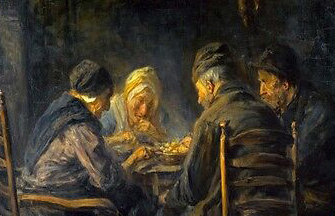
Potato-Eaters-Poor-Peasant-People-Eating-Dinner-Painting

Christ, in whom are hidden all the treasures of wisdom and knowledge. Colossians 2:4

 …For where two or three are gathered in my name, there am I among them. Matthew 18:20

It has been very quite on this blog, mainly for two reasons.

Firstly, Revien and I bought a school a little over a year ago. To say that I have never been busier in my life is an understatement.

There is an amazing back-story to how it all came about, which I may share here some day. Also, we have a sense where this could be going and why God sent it across our paths. If we are correct, that will be part of the story. But at the moment we are simply…busy.

Secondly, I have been involved in a personal research project that has left me somewhat dumbstruck, and that keeps on reminding me of Aquinas’ famous words to his secretary and friend, Reginald: “I can write no more. I have seen things that make my writings like straw.”

I am obviously still writing, but I do struggle to find words to convey what I have recently come to believe regarding certain fundamental matters of our faith. It is as though my senses need to adjust themselves to an intricate and unimaginable beauty that they never knew existed. To try and explain it through the medium of mere written words would be a bit like using smoke signals to discuss deep philosophy. The form can never do justice to the content.

A Tug of War

This reminds me of an age old problem that dates back to the Garden of Eden, namely the war between two types of knowing. Where is the eternal spring of knowledge? Is it within a person, or without? Who and what introduced the notion of subjective knowledge. Was it the Tree of Life or the serpent? When knowledge is discovered, can it be conveyed with words, or does it require an encounter of sorts on the part of the recipient – a type of enlightenment or illumination?

Study church history and you will soon find that people have murdered one another in the name of Christ because they could not see eye-to-eye on this matter. The battle continues to this day, albeit in a slightly more sophisticated manner.

Interestingly, on the side of the “absolute truth” theorists, the ecclesiastical canons are usually fired at words and connotation terms that are endowed with suspicion because their existence and content allegedly derive from the dark world of secular philosophy or even witchcraft. Dare to suggest that true meaning can only be discovered when accompanied by some form of personal experience and you have instantaneously distinguished yourself as one of the ideological offspring of that cursed race known as the existentialists. Or you are a mystic, which is almost like a gnostic, which is perilously close to an ancient form of paganism obsessed with penetrating the mysterious non-material realm of the gods and spirits in order to trip the light fantastic – a dubious goal which again links you to the anti-establishmentarianism of the sixties and the period’s obsession with everything Eastern. You are also a post-modernist, which means that you subscribe to chaos theory in some or other form, and that you have betrayed the cool, calm and collected world of enlightenment rationality by exchanging it for the pale counterfeit of subjectivism and relativism and a host of other isms that will certainly damage your immortal soul irreparably.

Is all of this true? I think not. I think a great part of the church suffers from an ecclesiastical version of what we used to call “combat neurosis,” or the “Nam syndrome,” or “bossies” here in South Africa (“little bushes” in Afrikaans, referring to the “bush war” of the seventies and eighties), and that is now more often referred to as PTSD or at least one of its derivatives.

As they say: “He has left the war, but the war has not left him.” This simply means that the coping mechanisms associated with defense and survival have eventually become a greater source of security than the absence of the war itself. Thus, I have to preserve the illusion of attack in order to justify the application of my defense system in order to keep my wayward emotions in check. For my apologetic system to remain intact, the heretics need to remain heretics, in other words. I wrote extensively about this elsewhere, and do not wish to repeat myself here.

The point is that there were indeed times when the church succumbed to gnostic tendencies, and Greek ideas of wisdom and ascendance, and dreams and visions that came from below and not above, and so on. Yet none of these qualify as irrefutable proof that God prefers to speak from without and not within. The abuse does not abolish the use, as they say, nor does it justify a retreat into the safe haven of protectionism.

Would the written code have been necessary if our ancestors chose to feast from the other tree? Again, I think not. The Scriptures tell us that life comes with its own light: “In Him was life, and the life was the light of men.” Partake of life, and share in the awareness that is unique to it. This is a knowing that transcends the intellect, a covenant knowledge that ensues when two lives blend together as one and share in each other’s consciousness. “Adam knew his wife Eve, and she became pregnant and bore a son.”

This knowing is different to the knowledge of good and evil in the sense that it is deeply intuitive and relational, and can never be reduced to a series of propositional statements that can be “taught” in the way that I have been explaining the secret life of atoms and molecules to my Chemistry students over the past few years.

The knowledge of good and evil is very much like those lectures – a type of knowing that relies on a classification of sorts, a binary distinction between irreconcilable opposites: Positive and negative, protons and electrons, on and off, one and zero, chaos and order, yin and yang, right and wrong, and so on.

The seduction of this knowledge lies in the illusion of control that it imparts, the seeming ability to run the program at will, the insidious pride that comes with the awareness of wisdom: “I know that I know.”

This type of double-knowing sets the knower apart from the knowledge, as though standing outside of it. To know good and evil is to become clinically detached from good and evil, to force a divide between subject and object. Here there is no encounter with life, no knowing from within. All that remains is the cold objectivity of the outsider, and the ensuing ideology that attaches itself like a leech to the knower.

Here the religious dilemma arises: “What good thing must I do to inherit eternal life?” I construct a dogma of goodness, but goodness itself evades me. My creed masquerades as enlightenment, blinding me to my blindness.

A Personal Reflection

Reflecting on the above, I am reminded of a question that has been nagging me for some time: Why have I lost my taste for so much of my previous Christian experience?

On the one hand, it is a worrying thought. Much of what I had deemed essential for momentum and eventfulness in my Christian life have simply gone stale. I look at those allegiances now as I look at the box of old toys that survived my childhood, my children’s childhoods and decades of storage in between. They represent a lot of things: Precious memories, nostalgia, perhaps a bit of money (some rare Dinky Toys from the Sixties), and so on. But one thing evades me: The exhilaration of playing with them. Try as I may, I simply cannot conjure up the magic that once kept me spellbound for hours on end.

The worrying part is the realisation that a great part of my early Christianity has gone the same route, that there is no way of rekindling it, and that my faith is heading the way of the Dinosaurs if that is all there is to it. I flip through the Christian channels and I see talking heads. I see advertisements of revival meetings with Christian celebrity names splattered all over them and my disinterest startles me. I skip the Christian publications when I browse through the magazine racks at the bookshops and supermarkets. I send prophetic end-time emails to the trash without opening them.

On the other hand, I marvel at the blossoming of new romances in my life. I have always loved the Scriptures, but they have become more astoundingly alive in the past few years than ever. I seem more pathetic if I fail to pray regularly, and so my prayers have become as vital to me as breathing, and my neglect of them as suffocating as death itself.

But perhaps most surprising of all is the enchantment of face-to-face fellowship with mere brothers and sisters; non-extraordinary Christians who do not have testimonies of signs and wonders and miraculous breakthroughs and financial blessings and astounding visions and maximizations of potential.

When we meet there is no “there,” no elusive destiny or some or other anticipated happening that will authenticate God’s worthwhileness and provide a raison d’etre for our togetherness. We are not bound together by any common goal or holy place or name or teaching, but by a shared participation in the divine nature.

Aside from Ephesians 4’s maturing of the bride and Romans 8’s ushering in of the age to come, no one is waiting for anything. There is no lusting after any anticipated dramas or breakthrough occurrences. The consensus is that God in Christ has broken through to humanity, and that our challenge is to discover and celebrate what is instead of yearning for what is not.

Remarkably, the dumbstruckness that I referred to at the beginning of this writing has evaded me in these settings. It has been no problem to share the unshareable in the presence of my brothers and sisters and Christ. And so I have become increasingly intrigued by the notion that truth seems to flourish in a relational atmosphere, that this is God’s chosen context for its conveyance, and that it’s life-giving properties are rapidly diminished when individuals unknown to us channel them through the airways, the printed page or the screen. Why else would the greatest preachers of this age not have the same effect on me as the sincerely spoken words of the littlest Christian sitting at my table – words that seem like life to my soul?

And of course I am not saying that we should discard all records of words spoken for Christ’s cause by people whom we have not met. Only that they can never compare with the miracle that happens when two or three of us meet in his name and his word manifests itself as his living presence in our midst.

Is this not why we have a collection of passionate letters written to flesh and blood individuals – people known to the authors – as the sole legacy of the apostles, and not The Institutes of Paul? These letters are extensions of relational bonds and not clinical codes of conduct, or, as Berkhof put it, formulations of a “complex system constructed for their own entertainment by scholars in the quiet retreat of ivory towers.”

And so I can carry on, but of course I am also a stranger to many who are reading this. I will have to borrow John’s words: Though I have much to write to you, I would rather not use paper and ink. Instead I hope to come to you and talk face to face, so that our joy may be complete.

In Conclusion

I have a sense that I am not alone in this. There seems to be a growing revolt against the notion that theological insight resides in some or other punditocracy, that is, an elite inner circle of enlightened individuals who possess knowledge not accessible to the masses.

Just this morning I happen to read Walter Brueggemann on distributive justice:

“This justice recognizes that social goods and social power are unequally and destructively distributed in Israel’s world (and derivatively in any social context), and that the well-being of the community requires that social goods and power to some extent be given up by those who have too much, for the sake of those who have not enough.”

I took my pencil and wrote “and knowledge” behind “power.” Is it not time that we broaden our understanding of justice to include the most precious of all commodities, that of wisdom and knowledge? But to do so would necessitate a break with our preciously held belief that some people are more eligible than others as custodians of God’s truth. It would be a call to relinquish that most subtle power of all, namely religious ideology.

I foresee a return to the wisdom of the little people, emboldened and enlivened by the presence of Christ in their midst, when they meet in twos or threes or more. I see a hunger for truth that is true in the moment of relational encounter, never contrary to one jot or tittle from Scripture, but always as the pouring forth of that life that breathed out Scripture in the first place. And I see a collective disenchantment with the formulations of the super-apostles and religious ideologues and denomination-makers, the manna of yesteryear, the searching and categorizing of the Scriptures apart from Christ’s presence in our midst.

For this is the covenant that I will make with the house of Israel after those days, declares the Lord: I will put my law within them, and I will write it on their hearts. And I will be their God, and they shall be my people. And no longer shall each one teach his neighbor and each his brother, saying, ‘Know the Lord,’ for they shall all know me, from the least of them to the greatest, declares the Lord. 

Jeremiah 31:33-34


The Church of No Anticipation (Part 2)

MonkeyThe price for the exhilaration of anticipation is a high one. When we indulge our desires by creating a Jesus that promises to fulfill some or other expectation, we do so at the expense of our commitment to the real Jesus. We pay for banana fever with lettuce leaves.

The reason for the trade-off is simple: The rush that we experience has nothing to do with the divine nature of God, or the power of the Spirit, and everything with the strong emotions that accompany expectations. As such it is not a valid portrayal of the life-giving capacity of the object or ideal that we are focused on, but an entirely subjective emotion forged by our belief that it will impart life.

The Anatomy of False Faith

This explains why the enchantment of anticipation offers such a viable alternative to real faith. Anticipation is, in fact, a form of faith, and here lies the subtlety. It sounds like faith, it looks like faith and it feels like faith. To make matters worse, it is globally proclaimed as faith.

But of course it is not faith, at least not as the Bible defines it. This should be obvious from the very emotions that we are discussing. True faith does not produce sensual feelings, for its object cannot be detected by the senses. As such it is wholly indifferent to that which appeals to the senses. It is moved by reliance on God alone, regardless of any experience (or lack of it). In fact, the Greek word for faith, pistis, can be better translated as “trust,” i.e. a strong reliance on the person and character of God, rather than mere “belief” which carries the connotation of simply believing in the existence of God.

Faith means I believe without having to see, smell or taste. It means I trust before I partake. The character of God is primary, the experience secondary. It is only the believing who get to be nourished in the end. The rest are disqualified.

And so, for faith to remain faith, its experience must of necessity be wholly different to the experience afforded by images that stir up the sensuality of desire and anticipation. Faith is the only antidote for the human irresistibility to desire, for it is in fact unfallen desire – desire pure and uncontaminated. Faith is desire under the governance of trust. It endears the believer to the Giver, not to his gifts. Faith is desire as love, not as lust.

False faith is something entirely different. It tells us that the lettuce will turn into bananas if we believe hard enough. It is an extension of our own delusions, not the antidote. It feeds on and furthers the greed that got us into our predicament in the first place, rather than challenges it. It reduces God to the status of a cosmic genie whose powers can be harnessed if we follow the correct formula.

To use Bonhoeffer’s term, false faith is a “wish dream.”

With the above in mind, it becomes clear why the banana trick is counterproductive. When we use the charm of sensual excitement as a means to motivate people for God, we are in fact messing with their perceptions. Faith is then no longer seeing the unseen, in the sense of that which is invisible to the naked eye, but seeing the unobtained, namely that which is visible in other people’s lives but invisible in mine.

This explains the trade-off. When we sensitise people to that which is visible and tangible, we desensitise them to that which is spiritual. When we teach them to live by banana excitement, we rob them of their capacity to live by lettuce. Sensual desire and faith are like God and Mammon. You cannot have both. They are mutually exclusive.

Mediation, all over again…

When we try and engineer the excitement of religious commitment, we are in fact suggesting that there is some experience that eludes our hearers. The only way we can make people lust after life is to question the validity of the life presently available to them.

The irony is that once we stir up desire and anticipation, we effectively create a gap between life and its partakers, for how can we desire and anticipate something unless it is first established that we do not have it? By promising that God is going to show up, we suggest that he is not present at the moment, and so we undermine the very essence of what the New Covenant is all about.

Our obsession with experience is nothing but a new type of mediation, and we are every bit as enslaved to it as our forebears were with priests murmuring in Latin. The packaging has changed, but it is the same old content. It is still guruism, albeit in a postmodern form. And here lies the difference: The new gurus are the guys who can best stir up expectation.

A simple visit to the Bestsellers section of your local Christian bookstore should reveal this quite clearly. Note how many of those books follow the famous formula of the television commercial:

  1. This is where you are.
  2. This is where you want to be.
  3. This is how you can get there.

The relief and bliss that one experience when reading these types of books have little to do with God, his power or his peace, and much with the absence of unwanted emotions – emotions that are temporarily suppressed by the intrusion of expectation.

Like a big drug company, our business has become the tranquilisation of the masses. The problem is that we have created a generation of addicts – people who no longer know how to use their primary resources to cope with the disillusionments that are so much part of this world. Our faith is no longer resource based, it has become vision based. And here I am not talking about the resurrection and the new earth.

The way in which this has come about is all too clear. The quickest and most efficient way to deal with a grumpy monkey is to repeat the banana trick – to use a new round of anticipation as therapy for the disillusioned and disenchanted, or, if we are really clever, for the potentially disillusioned, that is, to repeat the trick before reality hits home. We tell them that 2018 is the year of breakthrough before they have had a chance to wonder why the breakthrough eluded them in 2017.

The point is that the wish dream has penetrated our churches at an alarming rate, and that the masses have become enslaved to a type of enchantment that is entirely reliant on expectation. This year is the year of breakthrough. The revival is around the corner. God is doing a new thing. We are about to enter the realm of the miraculous.

On and on it goes. Where it will stop, nobody knows…

The Cost of it All

Again, all of this comes with a price. As Proverbs grimly reminds us, hope deferred makes the heart grow sick. There are limits to our capacity for anticipatory excitement. Sooner or later we realize that we are on a fast train heading nowhere, and that swopping stations makes no difference. Inevitably, the day will arrive when we will have not only lost our taste for lettuce, but also our capacity to dream about bananas.

It has been my experience, both as a professional pastor for many years and in my present post-institutional Christian life, that hearts sickened by deferred hope is the new epidemic that is sweeping the ecclesiastical landscape like the Bubonic plague. Its victims are countless, and their final words before breathing their last always follow this line in some or other way: Why didn’t it work out like I was promised?

We are, it seems, picking up the tab for the hysteria that we have been inducing with our vain promises over the past few decades.

Some of us have been wondering about the new type of Christianity for a long time, and have finally reached a point where we make every effort to stay out of its way. It has, in fact, become entirely impossible for us to derive any comfort whatsoever from any form of Christian prediction, except that God knows what we need and that he will provide it as and when he wishes to (terms and conditions apply), that the believing dead will be raised incorruptibly and that this beautiful earth will be restored in all of its splendor.

So did Jesus ever say anything about all of this stuff? In Part 3 we will address this question.

(PS: For a number of reasons I have put that one on hold, but I’ll post when the time is right.)

The Church of No Anticipation (Part 1)

MonkeyIn the late 1920’s, a researcher with a name reminiscent of a character from a Hans Christian Andersen fairy tale – Otto Tinklepaugh – conducted a series of experiments at the University of California at Berkeley. Tinklepaugh’s subjects were macaque monkeys. He wanted to see what they would “learn” in a variety of settings.

In one experiment, a monkey was put on a chair. A piece of lettuce was placed under one of two empty cups on the floor while the monkey was watching. The monkey was removed from the room. After a few minutes, it was returned and released.

Here is an excerpt from Tinklepaugh’s notes:

Subject rushes to proper cup and picks it up. Seizes lettuce. Rushes away with lettuce in his mouth, paying no attention to other cup or to setting. Time, 3-4 seconds.

Tinklepaugh repeated the experiment using bananas, with the same result. There was a difference, though: The monkeys showed greater enthusiasm when uncovering the banana.

It should come as no surprise that monkeys love lettuce, but that they love bananas even more. Most people know this. What is surprising is the monkeys’ response to a slight alteration of the banana version of the experiment. Once the monkey was removed from the room, Tinklepaugh did something sinister: He exchanged the banana with a piece of lettuce.

Here is his record of what happened next:

Subject rushes to proper cup and picks it up. Extends hand towards lettuce. Stops. Looks around on floor. Looks in, under, around cup. Glances at other cup. Looks back at screen. Looks under and around self. Looks and shrieks at any observer present. Walks away, leaving lettuce untouched on floor. Time, 10-33 seconds.

A Life Lesson

Tinklepaugh’s experiment reveals something disturbing about the dark enchantment of anticipation, which is insightful for those of us who are interested in the present state of Christianity.

Note the setting of this experiment: A creature of God is exposed to the life that comes from God alone, and then given access to it – a life that is intended to fill, satisfy, nourish and sustain the creature.

But note something else: The single factor that has the potential of seriously undermining a perfectly natural and organic process, is the prospect of a type of life that is more appealing than the provided life. Furthermore, when the anticipated “higher” life fails to appear, the effect of the resulting disappointment is so intense that it overrides the creature’s normal appetite for life sources that appear less exhilarating, no matter how accessible or nutritious they may be.

Thus, there is a correlation between the excitement stirred up by anticipation (I’m gonna get me a banana!) and the eventual absence of life (Lettuce sucks!). The irony is obvious: Those who are most passionate about receiving life are oftentimes those who go away most hungry.

Note that that the only thing that trumps that which is most valuable and desired, is an improved version of the same thing – not another thing altogether. This explains why Satan does not appear to his minions as a red horned goat-man with a sulphurous body odour, but as an “angel” (or “messenger”) of light.

If it is life that we seek, then the greatest temptation is not to discard life, but to become greedy for it – to want more of it than that which is proper, available and timeous. Satan knows this, which is why he uses it so effectively to deceive people who are looking for God.

None of this should come as a surprise. The first three chapters of Genesis reads like a version of Tinklepaugh’s experiment, except that the subjects are human: Life provided, life eclipsed by higher life, life lost.

The very thing that God intended for his creation, conformity to his image and likeness, was flashed by Satan: “…you will be like God.” The appeal offered a shortcut to the destination that they were heading to, yet without the disciplinary restraint of the growth process and its comparatively humdrum nutritional requirements. The result, according to the Genesis author, was “desire”[1] – a sense of anticipation gone out of control, a feverish enchantment stirred up by the prospect of arrival without sacrifice.

The New Testament authors understood this dark magic well, and identified it as the core problem of humanity. According to them, both the “old self” and the “world” are corrupt because of one reason only: Deceitful desire.[2]

Furthermore, they understood the gospel and cross of Christ as uniquely designed to counter this force. Paul tells us that those who belong to Christ Jesus have crucified the flesh with its passions and desires,[3] and that they are uniquely free to live a life void of the momentum generated by desire and anticipation.

They live by faith, which means they are immune to the lusts of the eyes. They trust in the provision of their master, and bananas no longer mesmerise them. They understand that life comes from above, and stones turning into bread seem boring in comparison.

Our Present State

If we understand this, we would rightfully become suspicious of life-offerings that are out of reach, but that promise to become accessible based on some or other precondition. We would be skeptical of any form of energy, excitement or momentum that is generated as a result of anticipation. We would understand that idolatry has very little to do with the objects of our desires, and everything with the rule of desire in our hearts. We would understand that the single greatest potential idol in all of the world is Jesus Christ, and that he becomes so when commitment to him (along with its benefits) is presented as some or other ideal to be fulfilled, rather than as an immediately accessible reality through faith, regardless of whether it is accompanied by bells and whistles.

In short, we will stop believing in the type of Christianity that requires words like “dream,” “vision,” “destiny” and “best life” to sell itself, for we shall see it for what it is: A cheap trick designed to make Christ desirable to people who have never been liberated from the governance of desire in the first place.

The problem is that the desirable Jesus is never there when we get to him, and he has not been for there two thousand years. The even bigger problem is that we have responded to his absence not by questioning whether his anticipated form was real to begin with, but by creating a church machine designed to deal with grumpy monkeys.

Our counseling rooms are emergency wards for the disappointed. Our prayers are pleas for the evasive breakthrough to manifest. Our revival services are designed to churn out newer and better versions of the banana Jesus, forever hoping to maintain the levels of excitement that were stirred up by our initial idolatrous depictions of him. Our worship services are choreographed to incite anticipation. Our evangelism strategies are aimed at the needs of the seekers. Our books are saturated with jargon that promises deliverance, healing, prosperity, a better tomorrow and everything conceivable that we do not have but want.

And, of course, all of it is cloaked in religious rhetoric. We truly believe we have turned from the world to Christ.

We have created a monster, and we are working feverishly for him, thinking that we are working for God.

(End of Part 1. Part 2 will deal with the solution to our predicament.)

[1] Genesis 3:6

[2] See Ephesians 4:22 and 2 Peter 1:4

[3] Galatians 5:24

Goodbye, Mr Cauvin

Screen Shot 2016-06-10 at 8.01.26 PMHere’s a scenario…

It’s the year 96, and John is on Patmos. He’s had a second vision, and it is extremely disturbing. He is told not to disclose it, which relieves him greatly. The vision is dark and absurd beyond anything he could ever have imagined, and he is convinced no one would believe it.

In the vision he is shown a strange type of rectangular scroll, one that glows and that can be unrolled by pressing a circle on it. It contains a discussion amongst followers of Christ during the start of the great apostasy.

The discussion is about something called Neo-Jehanism. Turns out a man by the name of Jehan is going to become a big name amongst the saints centuries into the future, and gather millions of followers behind him. But not everyone will find him or his teaching appealing, and so another saint by the name of Zoonhermans would rise up and oppose him, also gathering millions of followers behind him.

 Ultimately the schism would become so absurd that it would be be narrowed down to something called the Five Statements of Jehan, composed to refute the arguments of Zoonhermans’ followers. During the times of the end, the Five Statements would be summarized by a set of letters that would serve as a type of code for determining whether one is a “Jehanist” or a “Zoonhermian.”

 The befuddling thing about the vision is that saints from all over the world would feel the need to place themselves into one of these two categories, and provide reasons for doing so.

 To make matters worse, each group would be severely divided amongst themselves: The Jehanists would be made up from hundreds of strange named clan-types who would constantly be bickering and arguing amongst themselves: The Elders, the English, some from the Immersers, and so on. The Zoonhermians would be made up of clans like the Method Makers, the Festival Goers, the Gift Receivers, many from the Immersers, and so on…

It’s winter here in South Africa. A friend gave Revien and I a truckload of wood last week, and so the two of us spent the best part of Saturday sipping Cappucinos and listening to the crackling of a blazing fireplace and some great music.

That was the nice part.

But then I began to fiddle on my Ipad, and stumbled onto a five year old Classic iMonk post with almost three hundred comments. The Calvinists and Arminians were at it again, and of course I felt obliged to follow the whole thing and ride it out. Right to its very end.

But it left me feeling strangely empty and fatigued. And wondering what on earth the point was of it all, and what Paul and Peter and John and the others would have had to say about it.

To make matters worse, I spent the previous Thursday doing research for a project that involved tracing the origins of Calvinism’s famous TULIP acronym, only to be reminded that it never existed before the twentieth century.

For those who are interested: Its first known use was in 1905, when the American Presbyterian minister and hymn writer, Dr. Cleland Boyd McAfee, was heard using it at the Presbyterian Union Of Newark New Jersey.

And even then it was not fully developed. McAfee’s “U” stood for Universal Sovereignty, not Unconditional Election.

Of course it is said that the so-called Five Points are much older than that, dating from 1619 and the famous Synod of Dordt, where they were stated in response to the Five Articles of the Arminian Remonstrants. But even that does not solve the problem of TULIP’s relative late arrival at the Calvinistic party. Not all Calvinists are wildly excited about the acronym, or convinced that it faithfully represents Dordt. As Kenneth Stewart put it in  The Points of Calvinism: Retrospect and Prospect:

There is the striking fact that twentieth-century writing on behalf of TULIP has only very infrequently engaged with the actual Canons of Dordt of which the acronym purports to be a paraphrase or summary. This meant, and means that writers have been implying the fidelity of the acronym as a rendering of Dordt’s meaning without ever being pressed to demonstrate that this fidelity exists in fact. To call the paraphrasing of Dordt by TULIP a ‘broad brush’ approach, is arguably too kind! Why has there been no inquiry as to whether there is actually a true correspondence between this alleged paraphrase of Dordt, and the actual intention of the Canons – widely available in English? We may well be overdue for a revisiting of the Canons of Dordt themselves – even to the point of quoting them, or making a fresh compressed summary of their actual contents.

That explains something I have often wondered about, namely why many Dutch Reformed dominees here in South Africa have never even heard of TULIP.

Thinking of all this, my cheery Saturday morning mood dampened, and in its place memories arose from over a decade ago. That was my post-Pentecostal period, during which I, too, earnestly tried to become a Calvinist.

The thing that I could not wrap my head around at the time (perhaps I should say heart) was double predestination, a term derived from John Calvin’s assertion that the decree of election is symmetrical with the decree of reprobation. In plain English, it means that the God whom I had come to know as the ultimate source of love had chosen to damn some to the very extent that he had chosen to save others.

Some are preordained to eternal life, others to eternal damnation; and, accordingly, as each has been created for one or other of these ends, we say that he has been predestinated to life or to death. (Institutes iii, xxi, 5)

To make matters worse, the “eternally damned” weren’t mere stats on some theological pie chart, but a significant portion of the very broken children, teens and widows that I had been ministering to for years as a pastor and shepherd. God chose the majority of them to be damned forever and no one shall stand in his way? Has God then become my opponent in the ministry? Was Jesus even aware of this? Would he be angry if he found out?

These were the crazy thoughts that haunted me. And so I devised a plan: I would become a four-point Calvinist. I would not limit the atonement, and my acronym would simply be TUIP. That would allow me to have the best of both worlds. I could still listen to MacArthur, and distribute recordings of Sproul’s The Insanity of Luther, and read Piper’s The Pleasures of God, and introduce a younger generation to Francis Schaeffer’s Trilogy, and collect Pink’s books, and dislike TBN.

I could have all of this without the nagging thought that there was something darkly terrifying about God, that perhaps he did not love my children as much as I did but hated them, that perhaps the whole unfolding nightmare would drive me to a place of such insanity that I would want to escape from this terrifying God, revealing myself to be one of the reprobate after all, and ultimately suffer the inevitable fate of joining the rest of them in a cosmic concentration camp where we would suffer forever without the merciful prospect of death by gassing or gun or suffocating under a pile of corpses – all of this so that God’s perfect sovereignty and justice would prevail.

I figured that I would never have to worry about any of this again. Calvin’s reference to a “secret decree” under the guise of God’s loving exterior would never give me another sleepless night, and I would never even have to wonder whether the decree was still secret after Calvin caused it to leak out.

All of this would magically vanish through a simple subtraction!

Which brings me to the flashback. I had to test my plan, and so I presented it to one of the brethren of my newfound Reformed community. The man had a formidable intellect, and was regarded as one of the more mature men in the group. I told him that I had made peace with the fact that I am a four-point Calvinist, and asked him for his opinion. His response was immediate and to the point: “We have a name for four-point Calvinists. We call them…ARMINIANS!”

Pop. That was it. There was no way out.

During that time another brother, whom I had grown to respect and love, proved to be somewhat more gentle in his approach. He used the term “inescapable conclusion” in reference to TULIP’s L.

And then there was the discussion where all of this was applied to the hopeless fate of non-elect children dying in infancy, which was perhaps the single most disturbing experience of them all.

I’ll spare you the rest. In the end, it all became too much and my effort to morph into a follower of a dead Frenchman by the name of Jehan Cauvin failed spectacularly. Which, in the long run, turned out to be one of the best things that had ever happened to me.

I put it all behind me, and conceded that my reasons for wanting to become a Calvinist (Cauvinist?) were infinitely stupid in the first place. It really had nothing to do with a desire to rethink my view of God, grace, election, free will, the atonement or anything else. These questions had been settled in my heart and mind years before, as a result of the teaching of the Bible, prayer, study, contemplation, fellowship, and simply walking with Jesus Christ through the thick and thin of life for two decades.

No, the reasons why I was attracted to Calvinism were all circumstantial. I can list them, but it is really unnecessary as the late Michael Spencer himself has already done a wonderful job in another one of his classic posts: Why Calvin is cool: An infomercial for Calvinism.

Note that Spencer starts the updated post with the words “Even though I am no longer a Calvinist, a lot of this essay is still true…”

Here’s some extracts from the post, providing us with a synopsis of Spencer’s reasons for calling Calvin cool, and perhaps providing some penetrating insights into the real reasons for Calvinism’s recent resurgence. Ironically, none of them has anything to do with the stuff that almost drove me batty over a decade ago, and ALL of them are to be found in other expressions of Christianity. (If one would only look!)

“Calvinists have their problems, but going the openness route or denying the authority of Scripture are not dangers in the near future…Calvinism is fired up about missions…Calvinism is the strongest resistance to the excesses and errors of the church growth movement…Calvinism is warmly God-centered…Calvinism is contending for the Gospel…Calvinism is evangelistic, when practiced and not just debated… Calvinism has a wonderful reverence for history… Calvinism has the best approach to cultural issues… Calvinism isn’t detoured into fads (Jabez, Left Behind etc.)… Calvinists are great apologists… Calvinists aren’t on television…”

Those things were all true, and wonderful, and available without having to become a double predestinationist! (or whatever it is called).

And so, in the end, I was happy to write a dear John letter to Mr. Cauvin. The whole thing was just a bad affair. I was attracted to him for the wrong reasons, which blinded me to his dark side and simultaneously ruined any possibility of other, more wholesome relationships.

These were the memories that surfaced on Saturday. And the, for a moment, I felt like phoning my old friend who had trashed my dreams of becoming a four-point Calvinist. I wanted to ask him: “How could you? How could you use a novel and questionable doctrinal construct, not a century old at the time and a babe in comparison with the doctrine of the rapture that you so despise, to bully people into a category of your own making and subject them to a ridiculous stereotype that flatly ignores their personal histories of following the Lord Jesus Christ and the teaching of Scripture to the best of their abilities?”

But of course it would be useless. I realized how little effect humanitarian considerations have on Calvinists when I read John Piper’s response to Thomas Talbott’s On Predestination, Reprobation, and the Love of God: A Polemic.

In fact, I reread it just now, and experienced a near irresistible temptation to get back in the fight and tell the whole world why Piper is wrong, and how both Scripture and common sense contradict him at every point, and why it is not okay to pray for your children thinking that they may be reprobates, and…

But then I’ll just go back there, and I’m not sure I want to do that.

Bye bye, John…


Confessions of a Charismatic Cessationist

IcefireIn the South African spring of 1999 I left the Charismatic fold. The timing was not intentional, but it coincided beautifully with what was going on in my heart. My ecclesiastical winter had finally passed. The cognitive dissonance caused by reading authors like Dietrich Bonhoeffer, CS Lewis and Watchman Nee, whilst enduring an outbreak of the Toronto Blessing in the denomination that had ordained me into the professional pastorhood, was something of the past.

I had discovered a new world, lush with expository sermons and void of emotional excess. I began devouring anything anti-Charismatic I could lay my hands on and was more than proud to call myself a Cessationist. And, of course, I told everyone in hearing distance to read the final, conclusive word on the Charismatic movement: John MacArthur’s Charismatic Chaos.

Nearly two decades of inner turmoil had left me seething with anger, and so, quite predictably, my rant soon became condescending, judgmental and pharisaical. I eventually realised that I needed to repent, but it wasn’t easy. There were people like David Wilkerson and Lee Grady, I had to remind myself. Pentecostals who did not fit the image of the stereotypical charismaniacs that I had created in my mind. And then there was a disturbing intellectual arrogance amongst some of my new found non-charismatic friends, something that made me feel at times that we were worshiping an icy cosmic computer who would freeze every single time that we got the TULIP code wrong.

At the time I was reminded of an air-conditioning advert that I had once seen in a Time magazine: A man holding a fire in one hand and a block of ice in the other. That pretty much summarised my experience. I did not want either of the two, and I did not know how to bring them together.

But thankfully I was also reminded of something else, a lesson that the Lord had taught me many years before: Christianity is about the person of Christ, not about an ideology. In Him all things meet and hold together, even if we cannot figure out how this actually works.

And so I rediscovered my first love: The Lord Jesus Christ. I repented, and resolved to walk with him again, which happens to be the best decision I have ever made.

As I did, I was reminded that there exists no tension in Christ, that he truly “is our peace”. Not only does he reconcile us with one another, as the famous passage in Ephesians tells us, but he also reconciles our impossible theological dichotomies in himself. There are times when he sounds like a Charismatic (“…you do not know the power of God…”) and times when he sounds like a Reformed theologian (“…you do not know the Scriptures…”). We are clearly dealing with two realities of the person of Christ here, each of which will become corrupt and antagonistic towards the other when separated into its own little corner.

Perhaps this explains something of the sad divisions amongst us as Christians. Our Lord is so huge, so rich, so multi-dimensional, that one can find an aspect of almost anything somewhere in him. And so it is no big feat to do so and to enlist that part of him as an apologist for our particular theological crusade, making it appear that we are indeed his truest representatives.

No, the real challenge is much bigger. It is to deny that part in us that is peculiarly attracted to a part in Christ, and to allow all of him to consume us. Only then will we see the fullness of the Father in the face of Christ.

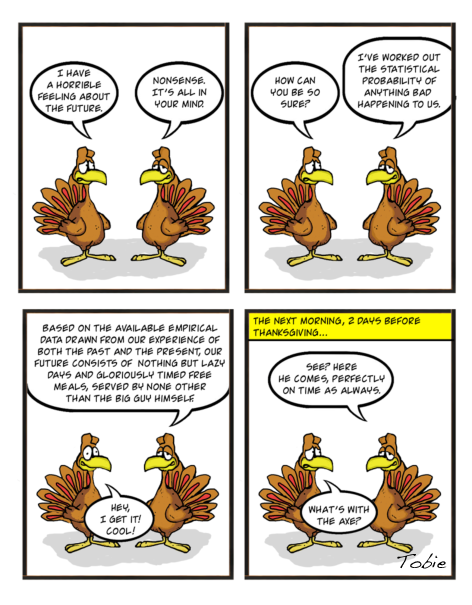
“I will”, said the Turkey.

2TurkeysB

I am indebted to Nassim Nicholas Taleb for the turkey analogy. Taleb borrowed it from the philosopher Bertrand Russel and used it in his provocative book The Black Swan to illustrate the folly of predicting the future by using the past as a point of reference. Along with scholars such as Daniel Kahneman (Fast and Slow Thinking) and Daniel Gilbert (Stumbling on Happiness) Taleb points out that humans are outrageously irrational when they try their hand at forecasting the future.

The topic intrigues me. As you may know, humans are most egotistical and idolatrous when they imagine what their own futures are going to look like. It is not our photo albums or mirrors that inspire self-worship, but our projections of an idealised future self. Our past and present selves are simply too real to be worthy of deification, and so we use the future to shape and mould the image of I.

All of this becomes rather interesting if we consider that the first motivational speaker in the history of the universe was a serpent. He convinced Eve that she could be more than what she was. He managed to divert her gaze from what she was and had in God to what she could have and be in herself, and thus from the present to the future. “Eve, you can maximise your potential. Eve, you can fulfil your destiny.”

Ever noticed that God identifies himself as “I am”, even in His self-declaration in Christ, but that Satan identifies himself as “I will”? Note the contrast:

I am who I am. Exodus 3:14
I am the bread of life John 6: 35, 48
I am the light of the world John 8: 12, 9:5
Before Abraham was, I am John 8: 58
I am the door John 10:9
I am the good shepherd John 10:11
I am the resurrection and the life John 11:25
I am the way, the truth, and the life John 14:6
I am the true vine John 15:1

“How you are fallen from heaven,
O Day Star, son of Dawn!
How you are cut down to the ground,
you who laid the nations low!
You said in your heart,
I will ascend to heaven;
above the stars of God
I will set my throne on high;
I will sit on the mount of assembly
in the far reaches of the north;
I will ascend above the heights of the clouds;
I will make myself like the Most High.’
But you are brought down to Sheol,
to the far reaches of the pit. Isaiah 14:12-15

Reading Isaiah 14, it is clear why John tells us that “the devil has been sinning from the beginning” (1 John 3:8). The seed of the serpent was forged in eternity before time, when the contentment and perfection of “I am” was replaced with the desire of “I will”. And so “being” was replaced with “becoming”, beholding with visioneering, the Creator with the creature, rest with striving, contentment with anticipation, the now with the then, the “thank you” with “if only”, the treasure of having with the emptiness of wanting.

Of course there was only one way in which the toxic seed of the serpent could be injected into God’s creatures, made in his image and likeness, birthed into his rest, partaking of his identity of life, enjoying the abundance of his provision. They too were to utter the venomous “I will…”

And so the serpent whispered to them: “You will… be as God.”

The moment they believed the promise, and acted on their newfound faith, they too were brought down to Sheol. Note that the first sin was in fact the second sin, but that it was like the first sin.

The enmity between the seed of the woman and the seed of the serpent began here. The “I will” became a collective in Genesis 11, when an entire nation aspired to penetrate the heavens and found a name and identity for themselves. “I will” became “we will”, and so the seed of the serpent that had become the seed of humanity became the seed of the kingdoms of this world.

Two Seeds, Two Births, Two Confessions

The enmity continues throughout Scripture and finds its ultimate manifestation in two births. The first came into the world and restored our understanding of the “I am” identity, the partaking in that which is and cannot become, for how can perfection be more than what it is?

This was the one who defied the arrogance of the serpent and his offspring, by saying “not my will, but yours be done.” This was the one who defined divinity in his “I am” statements, quoted above. This was the one of whom was said that he, “though he was in the form of God, did not count equality with God a thing to be grasped.” In each and every way he contradicted the aspirations of the serpent and his offspring.

Of course the serpent tempted him in the traditional, tried and tested way that had successfully led the whole word astray: “All these I will give you, if you will fall down and worship me.”

Note the underlying transactional and graceless philosophy that has governed all human relationships and marriages since the fall: “I will, if you will.”

But Christ resisted. As he would later say: “For I have come down from heaven, not to do My own will, but the will of Him who sent Me.” In the same manner, he taught us to pray “your will be done, on earth as it is in heaven.”

The first birth manifested the seed from heaven, and revealed its nature as that which is and cannot become, which has and cannot want, which beholds and does not imagine.

If the first birth was God’s Messiah and a revelation of his perfection, then the second birth is Satan’s messiah and a revelation of his imperfection and subsequent striving to “become”. As the seed of the woman brought Christ into the world, the seed of the serpent brought forth the exact opposite and antithesis of Christ, aptly referred to as “Antichrist”.

Naturally, the Antichrist is the incarnation of the human will and its striving, and so, in accordance with the first and second sin, and all the sins since then, he is made manifest in one way only: “He will oppose and will exalt himself over everything that is called God or is worshiped, so that he sets himself up in God’s temple, proclaiming himself to be God” (2 Thessaloninas 2:4). Naturally, for his coming “will be in accordance with how Satan works” (verse 9).

These insights reveal why it is futile and sinful to obsess about “tomorrow”, and why God has a habit of only providing enough manna for “today”. A focus on tomorrow is an inevitable invitation to idolatry, and so we are warned:

Now listen, you who say, “Today or tomorrow we will go to this or that city, spend a year there, carry on business and make money.” Why, you do not even know what will happen tomorrow. What is your life? You are a mist that appears for a little while and then vanishes. Instead, you ought to say, “If it is the Lord’s will, we will live and do this or that.” As it is, you boast in your arrogant schemes. All such boasting is evil. James 4:13-16

Do not boast about tomorrow, for you do not know what a day may bring. Proverbs 27:1

So do not worry, saying, ‘What shall we eat?’ or ‘What shall we drink?’ or ‘What shall we wear?’ For the pagans run after all these things, and your heavenly Father knows that you need them. But seek first his kingdom and his righteousness, and all these things will be given to you as well. Therefore do not worry about tomorrow, for tomorrow will worry about itself. Each day has enough trouble of its own. Matthew 6:31-34

Give us today our daily bread. Matthew 6:11

Then the Lord said to Moses, “I will rain down bread from heaven for you. The people are to go out each day and gather enough for that day. In this way I will test them and see whether they will follow my instructions… The Israelites did as they were told; some gathered much, some little. And when they measured it by the omer, the one who gathered much did not have too much, and the one who gathered little did not have too little. Everyone had gathered just as much as they needed. Then Moses said to them, “No one is to keep any of it until morning.” However, some of them paid no attention to Moses; they kept part of it until morning, but it was full of maggots and began to smell. So Moses was angry with them. Exodus 16:4, 17-20

Needless to say, the above insights have made me not only highly suspicious of the motivational revolution of the last few decades, but especially of its recent infiltration into the church world. A quick visit to the Google Ngram Viewer (an online phrase-usage graphing tool indicating usage of words and phrases in more than 5 million prominent publications) reveals the following disturbing trend:

Screen Shot 2014-10-29 at 6.13.30 PM

All of this has prompted me to rethink the contemporary hallowed usage of the word “destiny” amongst Christians. Wondering if the word is actually used in the Bible as it is currently being used on the covers of Christian bestsellers, I went to my concordance. This is what I found:

But as for you who forsake the Lord and forget my holy mountain, who spread a table for Fortune and fill bowls of mixed wine for Destiny, I will destine you for the sword… Isaiah 65:11-12

Oops…

Correct me if I am wrong, but it would appear that even the great apostasy is no longer in the future, but in the present.

The Key to Hebrews 6:4-6

Falling25:12 For though by this time you ought to be teachers, you need someone to teach you again the basic principles of the oracles of God. You need milk, not solid food, 13 for everyone who lives on milk is unskilled in the word of righteousness, since he is a child. 14 But solid food is for the mature, for those who have their powers of discernment trained by constant practice to distinguish good from evil. 6:1 Therefore let us leave the elementary doctrine of Christ and go on to maturity, not laying again a foundation of repentance from dead works and of faith toward God, 2 and of instruction about washings, the laying on of hands, the resurrection of the dead, and eternal judgment. 3 And this we will do if God permits. 4 For it is impossible, in the case of those who have once been enlightened, who have tasted the heavenly gift, and have shared in the Holy Spirit, 5 and have tasted the goodness of the word of God and the powers of the age to come, 6 and then have fallen away, to restore them again to repentance, since they are crucifying once again the Son of God to their own harm and holding him up to contempt. Hebrews 5:12-6:6

I recently contributed to a discussion on verses 4 to 6 above, and thought it would be helpful to share some of my thoughts here for those who are interested.

As you may know, these verses have proven to be a major stumbling block for many believers. They seem to suggest that it is impossible to repent and come back to the Lord after having “fallen away”. This is an obvious problem for those who have “backslidden” at some or other stage of their Christian walk, and who are trying to come back to the Lord.

It is also, and especially, a problem for those who have come back to the Lord after a period of backsliding, and who are haunted by the possibility that the Lord has not accepted them back or fully forgiven them.

Theologians generally try and escape the severity of these verses by going one of two routes:
1. They argue that the term “fall away” implies a total apostasy and denial of the faith, and not just a falling into sin.
2. They argue that the people referred to by the author were not really saved to begin with, and that they rejected the fullness of the revelation or enlightenment intended to bring them to salvation. If you reject the conviction of the Holy Spirit at such a level, then there remains nothing else that will convince you, hence the “impossibility”.

A Third Approach

However, there is a third way to approach these verses, and that is to look at the “big picture” of Hebrews. When we interpret the passage against the backdrop of the entire letter, especially with due consideration to the immediate context of verses 4 to 6 (beginning in 5:12), we find a message that is immensely positive and encouraging, and actually means the exact opposite of the above interpretations.

Let me start by pointing out that the error of both interpretations is the failure to interpret verses 4 to 6 in the light of verse 1. Does it not strike us as odd that the re-repentance that is prohibited in verse 1 is suddenly portrayed as a desirable but unattainable ideal in verse 6? In verse 1 we are told that repentance should not be repeated. In verses 4 to 6 we are told that repentance cannot be repeated. The author seems to be telling his readers that they are trying to do something that cannot be done, and that it cannot be done because it should not be done. Herein is the solution to the dilemma, as we will see in a moment.

“Once” and “Again”

To understand this, we need to understand the way in which the author juxtaposes the words “once” and “again” throughout the letter (e.g. 9:25-10:14). “Again” signifies the imperfection of the Old Covenant sacrifice, and “once” the perfection of Christ’s.

Keep in mind that the recipients of this letter were Hebrews, i.e. Jewish Christians. Also keep in mind that the Jewish nation as a whole rejected Christ due to the fact that they could not make sense of Christ’s Messiahship against the backdrop of their own religious traditions. The very shadows and types of the Old Testament that were intended to prepare the way for the Messiah actually blinded them to the Messiah. Jewishness, if not correctly understood, can prove to be a handicap in one’s grasp of New Covenant truths. It would appear that this was the problem addressed in the letter to the Hebrews.

To view the cross through an Old Covenant “lens” is to underestimate the finality of it. It is to see it as a sacrifice that should ideally be repeated regularly, in line with all the other sacrifices of that dispensation. This view would, quite obviously, manifest as an understanding of repentance as an associated act that also needs to be repeated again and again (repentance being the subjective response to the objective act of sacrifice).

And so the Hebrew Christians were not advancing towards maturity as they were laying again and again a “foundation of repentance from dead works” (verse 1, boldfaced in the text), in line with their understanding of a sacrifice as something that needed to be repeated again and again. This manifested itself as a need to have the “basic principles” taught to them “again” (5:12) which is, according to the Hebrews author, tantamount to feeding on milk, i.e. the first step associated with growth.

The impossibility of “repenting again” (6:4-6) is stated to emphasise the doctrinal absurdity of the idea, as unthinkable and impractical as “crucifying once again the Son of God” (6:6; 9:25-26). It is NOT stated as something that needs to happen but is now prohibited by an angry God who has run out of grace. In the New Covenant the repentance of regeneration happens once, because it is not the effortful turning of a human being, but rather the “perfecting for all time those who are being sanctified” 10:14. (This type of foundational repentance should not be confused with daily and ongoing “repentance”, which is legitimate and necessary, and not referred to in these verses.)

This is confirmed by the words in verse 1 “let us leave the elementary doctrine of Christ and go on to maturity, not laying again a foundation of repentance from dead works”. Thus the entire passage speaks against re-repentance, and identifies it as the cause of the Hebrews’ spiritual immaturity. The “impossibility” of verse 4 is intended to reinforce this truth, revealing that the New Covenant was never intended to provide an opportunity for re-repentance (Also see 10:26). In fact, this is not merely undesirable but impossible as we are no longer the ones overseeing the act of sacrifice. This Lamb was provided by God, and he only provided one.

The reason for a single sacrifice, resulting in a single repentance, is simple, and clearly stated in other passages in Hebrews:

Nor was it to offer himself repeatedly, as the high priest enters the holy places every year with blood not his own,for then he would have had to suffer repeatedly since the foundation of the world. But as it is, he has appeared once for all at the end of the ages to put away sin by the sacrifice of himself. (10:25-26)

He entered once for all into the holy places, not by means of the blood of goats and calves but by means of his own blood, thus securing an eternal redemption. (9:12)

And the clincher:

Since the law has but a shadow of the good things to come instead of the true form of these realities, it can never, by the same sacrifices that are continually offered every year, make perfect those who draw near. Otherwise, would they not have ceased to be offered, since the worshipers, having once been cleansed, would no longer have any consciousness of sins. But in these sacrifices there is a reminder of sins every year. For it is impossible for the blood of bulls and goats to take away sins… And by that will we have been sanctified through the offering of the body of Jesus Christ once for all. (10:1-4, 10)

Note that Christ came to not only forgive our sins, but to “put away sin”, to secure an “eternal redemption”, and to sanctify us “once for all”. Also note that the Old Covenant sacrifices could not provide any of this. If they did, two things would have happened:
1. They would have stopped being offered. In other words, the “repetitious” cycle would have ceased.
2. The worshipers would no longer have any “consciousness of sin”.

Clearly the Hebrews never understood this. The absence of both these elements in their (Old Covenantal) understanding of the cross manifested itself in a constant need to re-repent. Indeed, the need for repentance flows from a consciousness of sin. If the sin is not “put away”, the effects of the repentance would be short-lived.

The superiority of Christ’s sacrifice is thus best expressed in a new type of repentance that mirrors the completion and perfection of Christ’s sacrifice. The repentance on earth is what the sacrifice is in heaven. It reflects the perfection thereof, and thus it cannot be repeated.

The point is that these “problematic” verses of chapter 6 are intended to liberate, not condemn. They have nothing to do with the unpardonable sin, and everything with the glorious reality that to fall into sin is not to entirely undo the benefits of the cross, calling for a ritualistic repetition thereof. All that is needed is to get up and carry on, mindful of a secure salvation that has perfected us, even though we stumble and fall regularly.

In Conclusion

Much of my early Christian life was spent around believers who regularly ended up on the carpet between the front pew and the pulpit of the church, crying and begging for forgiveness. Sundays were mostly “repentance day”. We were evangelized. And then we were evangelized again, and again, and again. I think part of it had to do with the revival culture of the denomination, and the romance of tent evangelism, and the sovereignty of the altar call, and the centrality and supremacy of the sinner’s prayer, and so on.

As a kid I was given a little red Gideon’s New Testament containing a neat blue line on the back page where you were supposed to enter your “salvation date”. I changed that date so many times that I eventually lost track.

Strangely, in the midst of all the feverish activity there was a severe lack of spiritual maturity, both in my life and the lives of many others.

I could never understand this strange dichotomy, until I discovered the letter to the Hebrews. And then it became clear. We were like a man who got stuck in a revolving door. We were running, yes, but we were running in circles. We kept on repeating our entrance, and we never got anywhere. The very thing that was intended to make our spirituality “take off”, anchored it to the ground in a devastating way.

And oh boy, were we ever “conscious of sin”!

The letter to the Hebrews blew my mind. It provided a blue print for spiritual growth, and taught me that faith is to grasp the reality and finality of my own salvation. It showed me that humans once were the active agents in the ritual of sacrifice, but that God took over from us with one final, perfect sacrifice. We were now at rest, for God had finished his work. And it was so perfect that even the very thought of trying to repeat it bordered on blasphemy.

In fact, I began studying the book of Hebrews so much that I believe I have found a most likely candidate for authorship, but that is another story for another day…

(Please note that this short explanation merely scratches the surface and obviously does not deal with any of the questions that will/may arise from it. Yet it provides a basis from where one can do your own study. But feel free to ask questions. I’ll gladly respond.)