The Glorious Church

It has been almost five years now since a group of us started meeting weekly in a house in one of the suburbs of Bloemfontein.

We have never had a name or the need for one. In fact, we have been highly suspicious of church names since the outset (See related blog posts here and here).

Recently I decided to do a blog for our fellowship, and so I was faced with the dilemma of a name. There was only one that I could truly embrace, that accurately reflected what I had come to learn and believe about the glorious church of Jesus Christ over the past 3 decades of my life: The church’s name is… The Church.

Of course I mean “Church” in the sense of the Biblical “Ekklesia”, that is, the “Assembly” or “Gathered Community”. I certainly do not mean it in any one of the other ways sources like Webster define it, such as “a building for public Christian worship”, or “a religious service in such a building”, or “a Christian denomination”.

Some of us appear to have a need to read more into this word than what the New Testament means by it. The error is quite understandable. Apart from the words that we use on this planet to speak about the Godhead, it is the single richest word in existence. Of course such a word calls for scrutiny and exploration. Of course it seeks an expression that will truly reveal its essence. Of course it calls for all kinds of synonyms.

But in doing so we need to go deeper, not wider. Such a word can never be expanded. It has to be expounded. And you are not doing so if you use adjectives like “First”, “St. John” or “Shekinah”. Even “Covenant” and “Grace” do more to detract from the glory of this word than add to it. If you choose to highlight one attribute associated with the Ekklesia you inevitably make the others fade into the background. Church names, like idols, have the habit of turning on you in the end.

There are great synonyms in Scriptures for the Ekklesia, such as “the wife of the Lamb”, “temple”, “body” and so on. These will take you deeper, not wider, and they should be reserved for that purpose. There are others, too, and even if you manage to fit all of them on the sign outside your building, they will still mean nothing to the casual observer. To truly understand something of the church’s nature requires the best part of a lifetime, which means you can save yourself the trouble of trying to provide a synopsis by cramming a selection of her attributes into a name.

There is no name more beautiful to me than my wife’s, for it represents to me all that she is. She need not be called The First Glorious Revien Beautiful Wife Mother Lover of the Cedars of Lebanon (yes, she descends from there), for I know her to be all those things. I may whisper them to her, but I have no need to see them printed in her passport. This knowledge is reserved for those who are close to her.

Less is more, we often say, and this is truer about the name of the church than most anything else. Writers know that one of the golden rules of their trade is to never overstate the obvious. In fact, you should hardly ever state anything that your readers can figure out for themselves. Don’t preempt the mystery. Don’t rob them from the exhilaration of the quest and the glow of discovery. Refrain from the temptation to mediate the revelation. Trust God’s Spirit to decode their parables.

And so we adopted the only naming convention that we can find in the Bible. We called ourselves “The Church in Bloemfontein”, followed by the street address of the house where we meet. We make it very clear on our blog that the name does not belong to us but to the body of Christ in Bloemfontein, that we are not the only church in Bloemfontein and certainly not more officially so than any other one of the local churches. The only distinction is the address, which is part of our name for the sake of maintaining the principle of locality.

We’re challenging others who meet like us to do the same, although we certainly won’t split hairs about it.

What do you think?
Vital Organs

God has so composed the body, giving greater honor to the part that lacked it, that there may be no division in the body, but that the members may have the same care for one another. 1 Corinthians 12:23-25

Some time ago I was sipping hot coffee at a great restaurant in Johannesburg, when I found myself staring at the scene in this picture. I was amused and took a photo, certain that I would be able to use it to make some or other point in a teaching or article.

Well, the opportunity has arisen. A few weeks ago I read the well known words above, from Paul’s first letter to the believers in Corinth, and it ministered to me in an incredible way. It was clearer than ever, a perfect answer to a question that everybody (believers and non-believers alike) have been asking for at least seventeen centuries: Why are Christians so divided?

The passage above, I believe, provides the key.

But before we get there, consider for a moment the implications of this sentence: “God has … that there may be no division in the body…” That’s quite a statement. God has done something to prevent disunity in the body. There is a “secret” to Christian unity, and the verse above fills in the blanks and reveals exactly what it is.

Paul begins his argument in the preceding verses. We treat our “unpresentable parts” with “greater modesty”, he says. That is where my picture comes in. We buy clothes to hide our bulging waistlines. We colour our greying hair. We are attracted to the services offered in the picture, and the reason is obvious: We spend time, energy and money on our unattractive parts, not the attractive parts. In short: We adore the unadorable.

In the same way, Paul says, God gives “greater honour” to the parts that lack it, and so makes them indispensable to the body.

Before we speak about the body of Christ, which is what Paul has in mind here, let us pause for a moment and consider how true this principle is in the human body. I have never seen a pair of kidneys on the cover of Cosmopolitan magazine, and I certainly do not ever expect to. Kidneys are not exactly… attractive. However, to compensate for this fact they have been given a function that is so incredibly essential to the health of your body that it has earned them the proud title of “vital organs.” And so that magnificent face of yours simply cannot expel them from the body, or look down on them, or say to them “I don’t need you.” In fact, one of the things that causes a healthy complexion is a well functioning pair of kidneys.

Which brings us to the body of Christ. The very same principle applies here. Note that God has “chosen the poor in this world to be rich in faith” (James 2:5). Also not that the “lowly brother” must “boast in his exaltation” (James 1:9). As Paul said to these Corinthians earlier on in the same letter, God chooses the foolish, weak, low and despised in this world.

Hmm. I am reminded of Kierkegaard who said that God always creates out of nothing, and that he can only use something after he has reduced it to nothing. This explains why Jesus Christ made himself nothing before he could be used by God. It also explains why things went terribly wrong for the great visionaries of the Bible before their so-called “sense of destiny” could find fulfillment. Think of Joseph, Moses and Peter, to mention a few. All of them were aware of a calling, and all of them had to lose it in order to find it.

Most of us are more or less aware of the Biblical pattern in this regard. Most of us know that the way to the promised land lies through the wilderness, that the cross precedes the glory, that brokenness is a prerequisite for service. But the verse above adds an important dimension to this principle. God empowers the weak for another reason besides the obvious ones that we are so aware of.

HE DOES IT TO MAKE THEM INDISPENSABLE TO THE BODY.

People who are insignificant according to the standards of the world are indispensable in the ekklesia of Jesus Christ. Their extraordinary gifts are crucial for the church’s health. She needs to be aware of this, protect them and care for them. The foolish, weak, low and despised in this world are the vital organs of Christ’s body. It is as simple as that.

I say this to my shame, but there was a time in my life when I turned my back on my brothers and sisters in Christ who did not see things the way I did. I became sick of their theological shallowness, their constant emphasis on experience and emotions, their hyped-up gatherings. At least that is how I experienced it. And so I turned my back on them and searched out likeminded spirits with whom I could discuss the books, authors and issues that interested me. It did not take long to find them, and when I did I rejoiced. We could be deep together. Really, really deep. So deep, in fact, that no else could find us. Except of course those gifted souls who were just as deep as we were…

I see things differently nowadays. Besides being obviously embarrassed by the pharisaical snobbishness that I had made myself guilty of, I have come to realise how incredibly shallow my so-called depth has been. Whilst my new friends and I had a roaring time debating things like supralapsarianism, we were missing out on a vitality that could only be provided by certain … organs. We simply did not have the fervour to save the lost that I had seen in that tent evangelist who could hardly spell his name. We did not have the compassion on the poor that I had seen in the theologian with the “mystical” tendencies. And so on.

Don’t get me wrong. I am not arguing for some happy ecumenism at the expense of Biblical truth. I am merely saying that different parts of the body have different functions, and that all of us run the risk of becoming severely deformed without the restraint provided by the unity of the body. We need one another. The thinkers need the doers who need the feelers who need the thinkers…

John Ruskin once said “When a man is wrapped up in himself, he makes a pretty small package.” I wish to edit that statement somewhat: When a man wraps up Jesus Christ with himself, he ends up with a pretty small Jesus.

The body is not an eye, or a collection of eyes. It is a body. One body with many parts, as Paul said to the Corinthians. One body with all its parts, for God has clothed the dishonourable parts with greater honour so as to make them indispensable.

The key to Christian unity is diversity. Ironically, we have allowed our differences to drive us apart instead of bringing us together.

(A shortened version of this article appeared in Bloemnews.)

Witness Lee: We Were Wrong

It took a lot of courage, but after an intense six year investigation the world’s most respected counter-cult organization, the Christian Research Institute (CRI), issued an apology under the heading: “We Were Wrong.”

President Hank Hanegraaff summarized the findings of his organisation’s research in a 50 page treatment of the matter (Christian Research Journal, Issue 32-06. See http://journal.equip.org/articles/we-were-wrong). Under scrutiny was a movement simply known as the “local churches” (without capitilisation), associated with the work of the Chinese Christian Witness Lee, who worked with and under the direction of the legendary Chinese martyr Watchman Nee.

Nee sent Lee to Taiwan in the late 1940’s to expand the work there, and was imprisoned for his faith soon after. Lee carried on with the work, which experienced tremendous growth under his leadership, and took it to the United States in the 1960’s. Today there are thousands of local churches worldwide.

For years many churches in the West called Lee’s work sectarian and even cultic, hence the investigation by CRI. Some of the accusations against Lee included anti-Trinitarian views and the “deification” of man, but both were refuted by the investigation.

The real unhappiness, it would appear, stems from Nee and Lee’s teaching that denominationalism is sinful and divides the one body of Christ. As with the churches in the Bible, each town or city should have only one local church, named according to location (e.g. The Church in Bloemfontein), even if they meet in different venues for practical purposes. Nee was so slandered for his criticism of denominational division that he once wrote “The Watchman Nee portrayed by them I would also condemn.” And Lee is still called a heretic by thousands, in spite of CRI’s findings.

Cultic? Perhaps we should not shoot the messenger because we do not like the message.

What’s in a Name? II

The What’s in a Name post (January 2011) has attracted quite a bit of traffic and some thought-provoking discussion, and so I was inspired to dedicate my weekly newspaper column to the topic:

Paul, called by the will of God to be an apostle of Christ Jesus … to the church of God that is in Corinth. 1 Corinthians 1:1-2

In the city of Toronto there is a church with the name The St. Francis National Evangelical Spiritual Baptist Faith Archdiocese of Canada. And no, it is not the longest church name in the world. Ever heard of The House of God which is the Church of the Living God the Pillar and Ground of the Truth without Controversy, Inc? It’s in Ansonia, Connecticut, in case you want to pop in for a morning service.

If you don’t feel comfortable going to a church where the sign outside takes more space than the parking lot, you can always go to one of the trendy “emergent churches”. They have short hip names like Apex, Liquid, Quest and so on. Or, if you want something really unpretentious, you can pay a visit to the Scum of the Earth church in Denver, Colorado. These guys are not only humble; they want everyone to know it.

Can you imagine if Paul had to write Colossians 4:15-16 in our day and age? “Give my greetings to The True Holiness Divine Revelation Church of the Apostolic Succession and to Nympha and The Church of Our Lady Of Perpetual Succour. And when this letter has been read among you, have it also read in Touch Not My Anointed; and see that you also read the letter from Touch Not My Anointed” (No disrespect intended; these are all actual church names!)

Perhaps we can learn something from the churches of the New Testament. They had no names but were named according to locality, loudly proclaiming that their only identity was to be found in Christ and Christ alone.

(Bloemnuus 4 February 2011)

Jesus’ Prayer for Unity

Holy Father, keep them in your name, which you have given me, that they may be one, even as we are one. John 17:11

Years ago I had the privilege of asking Dr John MacArthur (pastor-teacher of Grace Community Church in Sun Valley, California, and one of the world’s most eminent Bible teachers) about the verse above. If Jesus Christ prayed for unity, I inquired, why is the church divided into so many factions? His response was simple and to the point: Jesus’ prayer was answered. Christians are united in Christ, regardless of the absence of any visible evidence to the fact.

I have always held a deep respect for John MacArthur, but his answer really did not satisfy me. Like many others, I simply could not believe that the unity that Christ had in mind was merely the mystical union of Christ’s body in “heavenly places”. Surely this unity was an obvious conclusion after Pentecost and did not need to be prayed into existence by Jesus? No, I was convinced that Jesus prayed for a practical, visible expression of the spiritual unity between Christians.

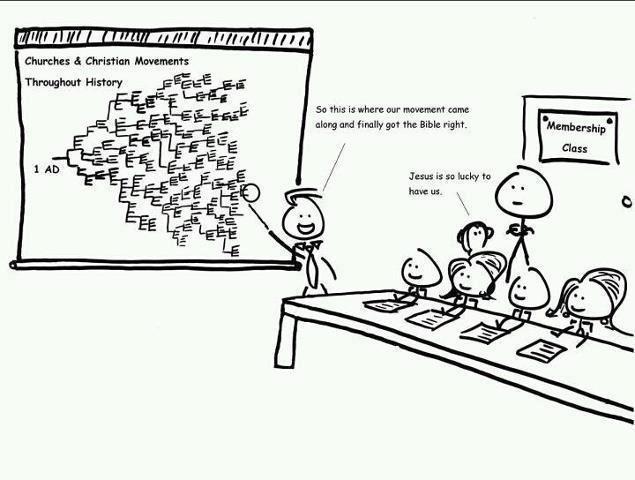
The main problem with my understanding of this issue has to with the seeming practical impossibility of it ever happening, which explains why many scholars are reluctant to accept it. Reformed Christians frown at Charismatics and call them happy-clappies, only to be called the frozen chosen in return. Catholic nuns have no desire to become fundamentalists, and so on. Denominations, it seems, are here to stay.

Yet it cannot be denied that millions of Christians worldwide are finding one another outside denominational boundaries on an unprecedented scale. Some prefer to remain in their churches, others are leaving in droves. Whilst European cathedrals are becoming museums, non-denominational house churches are mushrooming worldwide. This revolutionary new Christianity, it seems, is also here to stay.

So, instead of being critical, why don’t we rather ask: Is Jesus’ prayer being answered?

(Bloemnuus 9 January 2010)

Christ our Life

What then, brothers? When you come together, each one has a hymn, a lesson, a revelation… 1 Corinthians 1:30

When one studies the works of the great devotional Christian authors a common theme emerges: The centrality and sufficiency of Jesus Christ. Writers like Andrew Murray, Oswald Chambers, A.W. Tozer and Watchman Nee did not become famous because of great literary skills but because of their unswerving commitment to Jesus Christ. The title of one Nee book summarises it well: “Christ, the Sum of All Spiritual Things”.

Countless Christians have drawn the same conclusions as these writers without ever having read their books. The reason? They read the Bible, and the focal point of the Bible is Jesus Christ. The New Testament paints a much more comprehensive picture of Jesus Christ than the traditional ones that many of us have grown up with. For instance, millions of Christians have been taught that Christ died for us, but only a fraction of them realise that he also lives for us. As Paul wrote: “I live no longer but Christ lives his life in me” (Gal.2:20). Living by the life of Christ is what Christianity is all about. In Col. 3:4 we read that “Christ is our life” and in 2 Cor.4:10 that the life of Jesus must be manifested in our bodies.

This glorious truth does not only apply to our personal faith but also to its corporate expression. When Christians gather together they do so to manifest the life of Christ. The body of Christ under the headship of Christ must be made evident for Christ to be revealed, and this can only happen when all members are encouraged to share Christ.

Worldwide Christians are beginning to do this, with remarkable results, proving that the priesthood of all believers is not just a theological idea but a practical possibility.

(Bloemnuus  26 November 2010)

What’s in a Name?

Is it any coincidence that the first man-made religious effort in history included a building project, the desire for a name and a split soon afterwards? I think not. Paul Zietsman, who is part of a house church down in the Cape, sent me the following:

Something I have been pondering for a while:

Is “denomination” not the actual stronghold of the institutional church?

Why do I think thus?

To unite together under a name (except that of Christ) is a phenomenon of man which first reared its head at Babel:

And they said, Come, let us build us a city and a tower, and its top in the heavens. And let us make a name for ourselves, lest we be scattered upon the face of the whole earth. (Gen 11:4)

I realised that without a name:

You cannot register and own property…

You cannot open a bank account…

You cannot apply for authorisation or recognition of your organisation…

You cannot be taxed…

You cannot blow your own trumpet…

You cannot peddle your brand…

You cannot hold people together…unless there is a greater binding factor…

To put it the other way around….If you remove the name (denomination) the institutional church cannot exist, it will collapse overnight. No buildings, or bonds, no payroll, no bank account. There must be a registered name to be a recognised legal entity. The New Testament church existed and flourished without these entrapments (individuals in the church owned property, assets etc. but not the church). The NT church was never a “legal entity” and therefore it was impossible for even the Roman Empire to get a grip on them. That is why governments in the East Bloc and China all approve of the state-recognised churches. They are registered, can be prosecuted and controlled. You cannot outlaw something that does not even have a name. They can forbid gatherings (as they do in some countries) but they cannot get a grip on this – as they cannot get a grip on the underground church. But as soon as a name is registered (guess who approves registrations, and thus who has an unspoken hold and authority over the church…and who can then make laws that govern those organistaions who apply for approval and recognition…and then lawsuits can be filed, like Laurie Gaum sued the Dutch Reformed Church for ending his employment.) A name gives the powers of this world control.

So now we see churches trying to form a unity, and they can become “inter-denominational” but they cannot drop the names altogether, because then they will cease to exist.

One Body Many Members

The body does not consist of one member but of many. 1 Corinthians 12:14


An elder in a small congregation once told me that they had had only two pastors since the founding of their church. “In between the two tenures”, he said,” we had no one to lead us. And so, for quite some time, we did everything ourselves: The preaching, the visitation, everything.” He then paused and muttered: “That was the only time that this church did well.”

At the time I thought that the congregation must have had some bad luck with their two ministers and experienced some exceptional grace from God during the period that they were without one. This, of course, is quite possible. But I am more inclined to think nowadays that the little church had inadvertently stumbled upon one of the greatest and most neglected truths of the Bible, namely that the ministry of Jesus Christ takes place through a body and not through one extraordinary individual.

In one of Jesus’ most ignored statements Christian leaders are expressly forbidden to let people address them by using titles. The reason? Jesus alone is our Rabbi and Master (Matthew 23:8-10). Bestowing a special title on a Christian leader is a case of mistaken authority. The result is that we open ourselves to be led by the teachings of humans instead of the teachings of Christ. Furthermore, Christian ministry then looks like a profession instead of a lifestyle.

This does not mean that your hardworking minister is insignificant or not worthy of support. On the contrary. What it does mean, according to Jesus, is that he is but one of many brothers. And so all the other brothers and sisters are called to unite with him, under Christ, to express the will of their one Master.

(Bloemnuus 29 May 2010)