The Cult of Selfism

But mark this: There will be terrible times in the last days. People will be lovers of themselves, lovers of money, boastful, proud… having a form of godliness but denying its power. 2 Timothy 3:1-4

I recently came across an interesting quote by Oswald Chambers, the author of the Christian classic My Utmost for His Highest. He writes: “Self-realisation is anti-Christian. All this is vigorous paganism, it is not Christianity. Jesus Christ’s attitude is always that of anti-self-realisation. His purpose is not the development of man at all; His purpose is to make man exactly like Himself, and the characteristic of the Son of God is not self-realisation but self-expenditure.”

Chambers, who passed away in 1917, never lived to see the prophetic significance of his words. He never lived to see a day when Christian bookshops would be stocked with books telling Christians how to maximize their potential, how to make God’s dream for them come true, how to claim their miracles, how to prosper financially, and so on.

It seems that a large segment of the church has succumbed to the philosophy of the motivational revolution, and, in the process, to the spirit of the age. The motivational paradigm has changed the way we think about ourselves, our work and our destiny. To quote Paul Vitz, who have written extensively on what he calls The Cult of Self-Worship: “All the major theories of motivation and personality assume that reward for the self is the only functional ethical principle.” Certain Christians appear to have embraced this way of thinking, and in the process have become devoted to what Vitz calls “selfism”.

Perhaps it is time to heed Chambers’ prophetic wisdom and reassess much of what we have been teaching lately in the name of Christ.
It’s Dark Down Here

Christopher Hitchens is facing death. The famous atheist recently lost his voice in his battle with esophageal cancer, and it appears that he will not be with us for much longer. Yet he remains steadfast in his atheistic convictions. He recently wrote to some of his fellow atheists: “Our weapons are the ironic mind against the literal; the open mind against the credulous; the courageous pursuit of truth against the fearful and abject forces who would set limits to investigation (and who stupidly claim that we already have all the truth we need).” The letter was also posted on The Richard Dawkins Foundation website.

Reading the above, I could not help but be reminded of an insight that came to me some months ago, inspired by the much publicised rescue of the trapped Chilean miners at the time. I wrote a newspaper column about it, which I gladly post:

The true light, which enlightens everyone, was coming into the world… He came to his own, and his own people did not receive him. John 1:9-11

The rescue effort of the trapped Chile miners glued the world to their television screens this week. One could almost hear a global sigh of relief with each spectacled miner emerging from underground.

As I watched the footage in the comfort of a living room filled with natural light and lots of oxygen, and with a view of a garden and blue sky outside, my mind drifted. There was a world of difference between my environment and the one these men had been confined in. Yet, after only 69 days, they had adapted themselves to their strange surroundings in a remarkable way. Their eyes had become accustomed to the absence of light, hence the sunglasses. They had settled in an odd routine with a variety of diversions to keep them busy and sane, and so they were scheduled for therapy to ensure a safe reunion with people who knew nothing about living in darkness.

And then I wondered: What if their wives were with them and children were born and raised down there? And what if those children eventually had children? How long would it take for any memory of blue skies and green forests to vanish completely, and for such references to be dismissed as “pie in the sky”? (You can’t prove it, so it cannot exist!).

And what would they do to a stranger who claimed to have been sent from above to save them out of the darkness, especially if he instructed them to leave their old lives and everything associated with it behind as the way of escape was extremely narrow?

They would label him insane. And so they did.

Mistakes were Made

The heart is deceitful above all things, and desperately sick. Jeremiah 17:9

Everybody else but me; everybody else but me
He was talking to those people back in Galilee
Anybody else but me
– Don Francisco

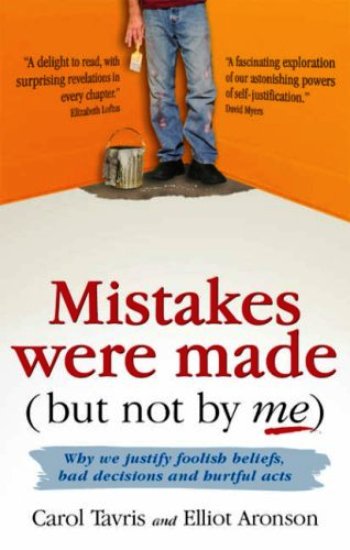
The most frightening book that I have ever come across in my life is not one that comes from the pen of Stephen King, Dean Koontz or any one of the many horror writers who earn their living by scaring people out of their wits. No, it is a book with the seemingly boring title Mistakes were Made (but not by me).

Written by social psychologists Carol Tavris and Elliot Aronson, the book is a fascinating study of the way in which human beings refuse to accept information that conflicts with their dearly held beliefs. Conflicting information causes ‘cognitive dissonance’, and the way in which the human brain reduces this mental discomfort is to create blind spots that blocks out the information that causes the dissonance. And so, Tavris and Aronson tell us, we end up deceiving ourselves in order to sustain our mental equilibrium.

This explains why we are attracted to information that confirms our own biases, why we love to play the blame game and why our memories are so highly selective. It also explains why a number of American presidents referred to their own massive blunders by saying ‘mistakes were made’, as though the mistakes made themselves.

The scary thing about the book is that it exposes the reader to the dark mechanisms at work in his (or her) own heart and mind, revealing how wrong we are when we think we are not quite as wrong as others.

I heartily recommend this book to all believers, especially to my fellow recovering Pharisees.

Lessons from a Lost Son

In his classic work The Return of the Prodigal Son Henri Nouwen offers some penetrating insights into the symbolism behind the younger son’s departure. He says: “Leaving home is living as though I do not yet have a home and must look far and wide to find one. It is a denial that I belong to God with every part of my being, that God holds me safe in an eternal embrace, that I am indeed carved in the palms of God’s hands and hidden in their shadows.”

The prodigal son experienced what we would call today an “identity crisis”, a term coined by the sociologist Eric Erikson to describe that period in our teens when we struggle to dissociate ourselves from our parents with the hope of forming a secure identity. This explains the turbulence of those years. We are like strangers in a storm looking for the bridge that will take us to adulthood and safety.

The prodigal tried to solve his particular crisis by dreaming of a “distant country” where he believed he would discover himself. He had not come to terms with the fact that he was the beloved of the father, and that this constituted his identity. Instead, he chose to be defined by the world.

In his book Nouwen draws a striking parallel between the prodigal’s fantasies and the temptations of Christ. Satan offered Christ instant gratification, worldly treasures and the acclaim of the people – a shortcut to self actualisation. Yet Christ resisted these: He had just heard the voice of his Father, saying “You are my Son, whom I love; with you I am well pleased.”

These words tell us who we are and where our true home is. When we are in touch with our sonship, as Christ was, we become immune to the onslaughts of the tempter.

A Love that Fills

As promised…

I bow my knees before the Father… that you may have strength to comprehend… the breadth and length and height and depth, and to know the love of Christ that surpasses knowledge, that you may be filled with all the fullness of God. Ephesians 3:14-19

The “fullness of God” is a subject that has been receiving a lot of airtime lately. Everyone wants to be full of the Lord, it seems.

The problem is that not everyone agrees on how to receive this fullness. Some think they need an evangelist to pray for them during a revival service and shout “Fill!” Others retreat to a quiet place, such as nature, and spend time in deep contemplation before the Lord, waiting to receive the Spirit’s fullness. Others believe that the Lord only fills the obedient, and so they try to live blamelessly. And so on.

Whilst all of the above may be perfectly legitimate expressions of Christian devotion, the Bible portrays the fullness of God differently. According to Paul, a Christian can only be “filled with all the fullness of God” as the result of a profound revelation: The comprehension of “the breadth and length and height and depth” of Christ’s love.

To know this love, Paul says, surpasses knowledge. It cannot be taught in a classroom, studied at a seminary or learned during a clever sermon. The lover does not use messengers. He himself wants to say to the beloved “I love you.” This explains why Paul does not lecture the Ephesians on this topic, but prays to God that he will reveal it to them.

The Bible is a divine love story. The good news is that you are the bride on whom the Bridegroom wants to bestow his love, and herein lies your fullness.

Think, Feel, Do

I always enjoy ‘light-bulb’ jokes and usually make an effort to remember them. My favourite ones have to do with church people:

How many Reformed Christians does it take to change a light-bulb?
As many as is needed to write a treatise on the theology of changing light-bulbs.

How many Charismatics does it take to change a light-bulb?
Seven. One to change the bulb and six to share the experience.

How many Fundamentalists does it take to change a light-bulb?
Change? Are you out of your mind?

You may smile, but these jokes convey an important truth. Different religious movements are usually known by the particular truths they tend to emphasise.

Throughout the ages certain denominations have excelled in the study of the Scriptures as well as in expository preaching and teaching, and they have been used of God to supply the church with mind-boggling volumes of rock solid theology. Others have emphasised a vibrant and personal relationship with God, and they have been used of God to fire up the hearts of God’s people. Still others have emphasised the fact that Christians are called to be holy and separate, and they have been used of God to resist the spirit of the age as it constantly seeks to infiltrate the church.

Who is right? Clearly they all are. We need the one as much as we need the other. We need the head, the heart and the hand. We need the thinkers, the feelers and the doers. Or, as Jesus instructed us, we need to love God with all our mind, all our heart and all our strength.

The challenge for Christians is to integrate all three these dimensions of our faith. Choose one at the expense of the others and you run the risk of ending up with intellectualism, fanaticism or pharisaism.

Catching the Wind

Peter said to Jesus, “Rabbi, it is good for us to be here. Let us put up three shelters – one for you, one for Moses and one for Elijah.” Mark 9:5

Peter’s awkward suggestion to put up three shelters on the mount of transfiguration presents us with a striking metaphor of our human tendency to try and capture the glory of God. It teaches us that God not only reveals himself to us in extraordinary ways at times, but also that we find it exceedingly difficult to deal with such revelations.

The history of the Christian church contains a number of remarkable and exceptional accounts of God’s intervention in human lives and churches. More than one supernatural incident has been reported by eye witnesses of the great revivals of previous centuries, and also by biographers of John Wesley, Andrew Murray and others.

However, church history also records that for every transfiguration a cluster of shelters is left behind. When the glory departs the shelters remain as hollow shrines – grim testimonies of our doomed efforts to prolong divine visitations, or even fabricate them.

These shelters come in many shapes and sizes, and usually differ from denomination to denomination. What they have in common is the underlying assumption that we are responsible to house the Spirit of God somehow, to make him stay with us, to possess and own him. We can try and do so by containing God in our creeds, in the imagery and statues of our buildings, or by scheduling healings and miracles as though God’s power is a magic at our disposal.

Let us remind ourselves that Jesus once likened the work of the Spirit to the wind, blowing when and where it wishes. We can capture God’s sovereign Spirit no more than we can catch the wind.

Christ the Revelation of God

Long ago, at many times and in many ways, God spoke to our fathers by the prophets, but in these last days he has spoken to us by his Son… He is the radiance of the glory of God and the exact imprint of his nature. Hebrews 1:1 -3

The hearing of voices from the other side has become a major industry in our day and age. Celebrity psychic mediums like John Edward pocket millions as a result of their alleged ability to communicate with the dead, whilst books documenting conversations with God, trips to heaven and meetings with angels constantly top the bestseller charts.

We all want to hear what God has to say, and the reason is obvious: God has created in us an insatiable appetite to commune with him. Our thirst for supernatural revelation is as strong as our survival instinct, for it paves the way to survival beyond the grave.

Where can a person find the voice of God? According to the Old Testament Scriptures, God spoke to his people in three primary ways: Through the prophets, the law and the angels. According to the opening statement of the letter to the Hebrews he now speaks through the Son, and so the first few chapters of this remarkable book conclude, quite logically, that the Son is superior to the prophets, the angels and Moses.

As “the exact imprint of his nature” the Son is a clearer disclosure from God than any revelation from the other side, no matter how fantastic or sensational. It as though God is saying “never before have I been represented so perfectly.”

Do you want God to speak to you? Forget about psychic mediums, angels, visions and traveling prophets. Focus on the Son. He is the eternal Word of God in the flesh.

(Bloemnews 22 February 2008)

On this Pleasant Rock

For though by this time you ought to be teachers, you need someone to teach you again the basic principles of the oracles of God. You need milk, not solid food, for everyone who lives on milk is unskilled in the word of righteousness, since he is a child. But solid food is for the mature, for those who have their powers of discernment trained by constant practice…. Hebrews 5:12 – 14

In a recent media article Doug Scott, the famous British mountaineer, criticized “a new breed of climber who wants pleasant rock”. “Pleasant rock” refers to a rock that has bolts all over it in order to make the climb safe and easy. Battery-driven drills are used to set the bolts all over crags, and so the need for real skill and experience is removed. The problem, according to Scott, is that it ruins the rock for anybody wishing to climb it traditionally.

Do I detect a parable for the church in Scott’s disapproval of this new trend? Mountains have always been a striking metaphor to symbolize the pursuit of spiritual enlightenment, and so it is not difficult to see the analogy: “Pleasant rock” is like easy Christianity, designed for the lazy pilgrim who wants to get to the top, but with the aid of easy steps worked out and passed down by someone else.

This lethargic dependency on a formulaic Christianity is reminiscent of the Biblical symbol of milk: The nutrient of the immature. Milk is predigested food, ideal for those who cannot do their own digestion. Meat, on the other hand, is for those “who have their powers of discernment trained by constant practice.”

Forget about easy steps and how-to’s. Maps for the narrow road do not exist. Spiritual discernment is not handed down, but comes through practice.

(Bloemnews 26 10 07)

Do you Speak Christianese?

…they shall call his name Immanuel which means, God with us. Matthew 1:23

It is ironic that some of Christendom’s greatest efforts to proclaim and exhibit God’s presence on earth have frequently caused exactly the opposite. God is usually obscured, rather than revealed, to the very degree that our religious attire, architecture, titles, music and language become strange and otherworldly. We then portray him not as “with us” but as distant, elusive and incomprehensible.

Our habit of speaking “Christianese” is a prime example. Like medieval ecclesiastical Latin, many of the terms that Christians use in everyday language is completely incomprehensible to people outside the church. Sadly, due to the fact that a number of Biblical Greek words were not translated into English but transliterated (the transcription of a word in one language into corresponding letters of another language without regard to the original meaning), Christians possess a distinct vocabulary that is gobbledygook to outsiders.

Consider the sentence: “A bishop and an apostle went to the church to speak to a pastor and a few deacons.” This sentence is not only unintelligible to a person untrained in religious language, but is also interpreted completely differently by people from different denominations. It is noteworthy that these terms had no religious connotation in the original Greek, but were everyday terms used to convey obvious meanings. And so a Greek simpleton in the first century would have understood the above sentence as “The supervisor and the delegate (or “sent one”) went to the gathering to speak to a herdsman and a few servants.”

The difference in meaning between the two sentences is astounding. The former is ambiguous whilst the latter portrays Christianity as a practical, functional, down-to-earth faith that calls for personal involvement.

God does not speak Christianese. He speaks in a way that we can all understand.

(Bloemnews 18 February 2011)