The Cult of Arrivalism: A Re-Post

Finally, my brothers, rejoice in the Lord. To write the same things to you is no trouble to me and is safe for you. Philippians 3:1

Some things are so vitally important that they need to be said more than once.

Years ago I wrote an article that is buried somewhere under the posts in this blog. I believe it to be one of the most important things I have ever spoken or written about. I also believe it to be more relevant today than ever before.

As many of the newer visitors and subscribers to this blog have not read it, I feel quite compelled to repost it. Please feel free to copy the content, post it elsewhere or distribute it in any form.

Blessings to all.

Tobie
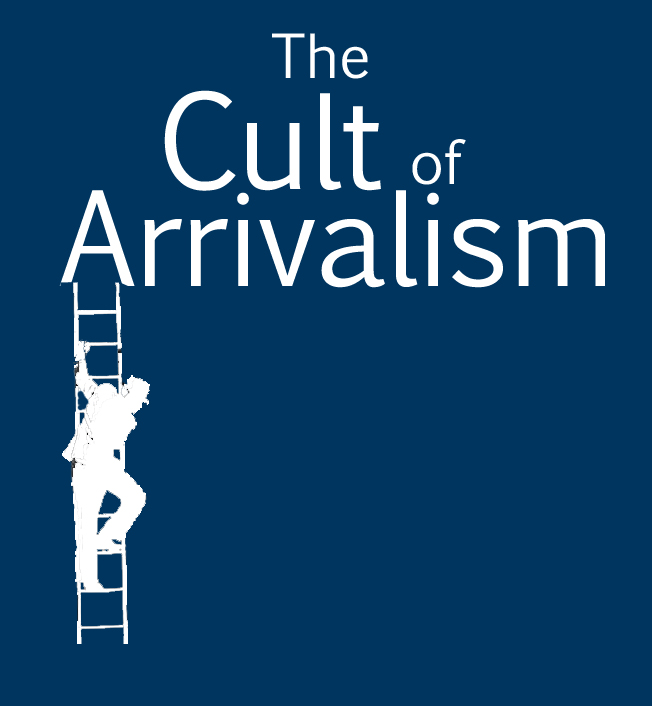
There is something wickedly satisfying about arriving first in life. This I learned at a tender age after my first success in beating my older brother to the kitchen table in our house in Namibia. Our lunchtime races down the long passage had become somewhat of a ritual, and, being the smallest, I was usually the last one to arrive. But when success did come it came sweetly. After all the thrashings, I enjoyed his defeat even more than my victory.

This is why I call it wickedly satisfying, for joy derived from another’s misfortune is wicked indeed. The Germans speak of “Schadenfreude” (leedvermaak in Afrikaans), that is, that warped sense of relief we experience when something bad happens to others instead of us. It explains why humans enjoy gossip and are morbidly fascinated with vehicle accident scenes, and it reveals something of the universal human drive to end up on top of the heap, to always win, to die with the most toys (See Ecclesiastes 4:4). The rat race is indeed an apt description of life on planet earth.

Ego-death a Non-negotiable

Many prophets and sages have warned for millennia against running this race, and they have done so in the names of many gods. Examples abound, but I will mention just one. Buddhists have a real issue with the ego, and they teach that “man is a bundle of desires”. The solution? If you remove the source of envy you also remove unhappy and resentful feelings about others’ possessions, they say. And so the Buddhist authorities in the Himalayan Kingdom of Bhutan have banned advertising.

The gospel of Jesus Christ, however, has a completely different approach to the matter. Instead of warning us against running the rat race, it tells us that we are rats. We are, therefore, perfectly consistent when we behave in the crazy ways we do. It is not our behavior that constitutes the problem, it is our identity. Hence the New Testament’s one and only prescription: The annihilation (read crucifixion) of the competitive rat.

Without this event, which we can call “ego-death”, any effort at Christianity is as sensible as attempting to climb Everest by staying at home. It simply cannot be done. The cross is no different to the guillotine, the noose or the electric chair. It is an instrument of death and serves the explicit purpose of executing the criminal. What a silver bullet and wooden stake are to a vampire, the cross is to the ego. The funeral of baptism is the funeral of self, and so 2 Corinthians 5:17’s “new creation”, resurrected in the image and the likeness of Christ, is a creation that seeks not to win but to serve, for this is what Christ came to do.

It was Adam and Eve, under the inspiration of the serpent, who thought that equality with God was something to be grasped, not Christ (See Genesis 3:5 and Philippians 2:6).

A Religious Masquerade

Egos, of course, hide well, and they hide best under cloaks of righteousness, which is why we so constantly run into them in churches. In the Bible religious self exaltation is personified by the sect of the Pharisees: “They do all their deeds to be seen by others… they make their phylacteries broad and their fringes long, and they love the place of honor at feasts and the best seats in the synagogues, and greetings in the marketplaces and being called rabbi by others.” Their dress code, behaviour in the religious assemblies, status and titles all conspire to elevate them above the masses, giving them the bizarre privilege of fusing the religious pilgrimage with the ego-trip, impressing God and people simultaneously, obtaining heaven with earth still in their pockets.

Winning means arriving first, as my early races down the passage taught me. To win one must have arrived, and winning religiously implies having arrived religiously. For clerical supremacy to survive some sort of arrival is required, and, as it happens in churches, a fitting doctrine is needed to prove and clarify the arrival.

A doctrine of arrival, put very simply, is a theologically constructed idea which proposes some final insight, experience or realisation of promise. It distinguishes the one who has arrived from those who are still on their way. It also offers a circumvention of the painfully humbling business of believing, hoping and waiting. Proud people do not wait well, which explains why God employs time so successfully in humbling his servants. Forcing arrival by fabricating a destination is humanity’s attempt to appear victorious and to bypass the discomfort caused by the impatience of the ego.

The Error of Realised Eschatology

There is no heresy as deceitful as the one which offers a shortcut to the Promised Land. Such impatience led to Adam’s sin, to Esau forfeiting his birthright, to the Israelites constructing a golden calf and to the Prodigal leaving the family home. Every time the underlying philosophy is the same: We want it all. We want it now

Since the time of Hymenaeus and Philetus, who taught “that the resurrection has already happened”, doctrines of arrival have littered the ecclesiastical landscape. Theologians speak of “realised eschatology”, that is, the erroneous and dangerous view that the blessings linked to the resurrection of the saints, the Lord’s return, the visible and final coming of the Kingdom and the restoration of all things are to be appropriated somehow in this world and age.

There are many modern day examples of this age-old heresy, for instance prosperity theology (the restoration of our finances and possessions), extreme teachings on healing (our bodies and health have been restored), obsession with signs and wonders (natural laws have been made subject to us), the conviction that doctrinal perfection is possible (we understand perfectly), elitist churches who believe that they have a perfect understanding and practice of “fellowship” (we love and meet perfectly), post-millennial Reconstructionism or “Kingdom Now” theology (we have the perfect political system) and the belief in sinless perfection (we are perfectly holy).

All of these, of course, are just different and novel ways of proclaiming “we have arrived”.

The Biblical Doctrine of Waiting

It was David who said “Wait for the LORD; be strong, and let your heart take courage; wait for the LORD!” This principle runs like a golden thread throughout Scripture. Abraham had to wait for the promise of a son to be fulfilled. Moses had to wait 40 years in the wilderness before God called him, and then another 40 years before he was afforded a glimpse of the Promised Land. The disciples had to wait for the promised Holy Spirit, and in the letter to the Romans we read that we “groan inwardly as we wait eagerly for adoption as sons, the redemption of our bodies.”

The Kingdom has come in part but not fully. We haven’t arrived yet, and the pain of the planet is one of God’s most efficient tools to remind us of this and to build our faith. The heroes of Hebrews 11 were all looking ahead to a heavenly country. They were not perfectly healed, prosperous, organised or, if you look closely, sinless. Their ‘perfection’ beckoned from a heavenly country.

The ironic thing is: To the degree that we want to drag heaven down here we cease to find it in our hearts, we cease to live by faith, in other words. Perfectionism in its many guises is nothing but veiled materialism. It is an insistence to make the intangible tangible, a refusal to live by faith.

The answer to all of these is quite simple:

For I consider that the sufferings of this present time are not worth comparing with the glory that is to be revealed to us. For the creation waits with eager longing for the revealing of the sons of God. For the creation was subjected to futility, not willingly, but because of him who subjected it, in hope that the creation itself will be set free from its bondage to decay and obtain the freedom of the glory of the children of God. For we know that the whole creation has been groaning together in the pains of childbirth until now. And not only the creation, but we ourselves, who have the firstfruits of the Spirit, groan inwardly as we wait eagerly for adoption as sons, the redemption of our bodies. For in this hope we were saved. Now hope that is seen is not hope. For who hopes for what he sees? But if we hope for what we do not see, we wait for it with patience. (Romans 8:18 – 25)

Christianity is a waiting religion. When we wonder why this is so, we are reminded by Scripture that we are “saved in hope”, and that “if we hope for what we do not see, we wait for it with patience.” Ultimately all waiting experiences are intended by God as exercises to strengthen us for the great wait: The day of his coming. Through them we are taught and reminded that the gratification of Christianity is not instant but deferred. Through them we learn to live by faith, not by sight.


The Blessings of Giving

The Lord Jesus himself said: “It is more blessed to give than to receive.” Acts 20:35

One of the strangest peculiarities of the human race is the hoarding habit. When it gets out of hand, psychologists call it “disposophobia”. The rest of us speak of the “packrat mentality”.

Different people hoard different things. Minimalists may frown at being called packrats, yet their bank accounts or foreign investments would usually confirm that that is exactly what they are. The rich are in fact the greatest hoarders, but we forgive them as it is more interesting to watch someone hoard Louis Vuitton handbags than what it is to stumble over your husband’s junk in the attic.

The sin of covetousness, which underlies the hoarding habit, is humanity’s most aggressive effort to compensate for the distinct sense of loss we experience without God in this world. It makes perfect sense, and explains why any effort at filling the hole in our soul is always met with further disillusionment.

As Rockefeller famously answered when asked how much money is enough: “Just a little bit more.” Centuries earlier Solomon said: “Whoever loves money never has money enough; whoever loves wealth is never satisfied with his income” (Ecclesiastes 5:10).

Jesus challenges the fallen and conventional wisdom of this world by pointing out that the ultimate answer for our ailments is not to keep on receiving, but to start giving. This teaching runs like a golden thread throughout the New Testament.

The words of Basil, Bishop of Caesarea in the fourth century, is worth quoting here: “When someone steals a man’s clothes we call him a thief. Should we not give the same name to one who could clothe the naked and does not? The bread in your cupboard belongs to the hungry man; the coat hanging unused in your closet belongs to the man who needs it; the shoes rotting in your closet belong to the man who has no shoes; the money which you hoard up belongs to the poor.”

Think about this for a moment. If the absence of God leads to covetousness, and covetousness to acquisition (let’s not use the word “hoarding” here, just in case you do not relate), then the presence of God should lead to contentment, and contentment to divine forfeiture (a.k.a. giving).

It is a huge subject, and one I have been contemplating since the early seventies. I had not yet turned ten when my mom took me to the drive-in to see Zeffirelli’s Brother Sun Sister Moon, and my life has never been quite the same. It remains my all-time favourite movie, and also the one that has inspired me the most.

Early this morning I received a notification of a post from one of my favorite bloggers, David McAnulty. It addresses the issue of the poor from a contemporary perspective, and I found it extremely meaningful. David says it so well that I prefer him to speak for himself. You can find it here.

Blessings to all.

(A few paragraphs of this post has appeared in Bloemnews.)

The Lord’s Supper: Losing Your Life and Finding It

If anyone would come after me, he must deny himself and take up his cross and follow me. For whoever wants to save his life will lose it, but whoever loses his life for me will find it. Matthew 16:24-25

Did you know that the act of partaking in the Lord’s Supper is linked to the passage above in a profound way?

The teaching below was given at a house meeting in Bloemfontein at the end of 2011. We gathered for our monthly love feast and shared the Word. Someone read an encouraging passage from the Bible, and the conversation turned to recent world events and the unprecedented anxiety experienced by millions all over the globe.

The teaching that ensued was not prepared. I certainly had never put it together in my mind as it came out. In fact, I was instructed just like everyone else. It was never intended as a sermon or podcast. What you will hear is a brother sharing with other brothers and sisters.

The Word, just like the bread that we broke that morning, is intended to be shared. And so I post the audio here for those who may be interested. There is some discussion at the beginning, which you may want to skip. The Scripture reading, followed by the teaching, is about 3 minutes into the recording.

May the Lord bless and instruct you as you listen to it, and please feel free to comment.

01 Communion Teaching

How Not to Not Love the World

Do not love the world or anything in the world. If anyone loves the world, the love of the Father is not in him. For everything in the world—the cravings of sinful man, the lust of his eyes and the boasting of what he has and does—comes not from the Father but from the world. The world and its desires pass away, but the man who does the will of God lives forever. 1 John 2:15-17

Do not love the world, John tells us. If you do, then the love of the Father is not in you.

The problem with some of us is that we turn from the world before we turn to the Father. And then, when we eventually do turn to the Father, we make the mistake of thinking that we have already (rather conveniently) forsaken the world. We may even conclude that we have some advantage over those poor souls who have not yet dealt with the issue of “not loving the world”.

If we hold to such a view, we have never come close to understanding John’s words. In fact, we may love the world very much whilst thinking that we have forsaken it.

The key to understanding John’s words is found in Jesus’ words: “Whoever loves his life loses it, and whoever hates his life in this world will keep it for eternal life” (John 12:25). “Loving the world” does not mean loving something that exists apart from you. Rather, it means that you love something in which you live and of which you are a part.

What I mean is this: You cannot separate the idea of your own “life in the world” from the idea of “the world”. The two are inseparable. And so, “loving the world” means loving some or other relationship, dynamic or interaction that exists between you and the world. This could be anything, and it differs from person to person, but the common denominator between all of them is what Jesus refers to as “your life in this world”.

It is this thing that you are not allowed to love. It is this thing that you are told to hate. It is impossible to not love the world whilst loving your life in it.

Some of us turn from the world as one would turn from a bad business partnership. Perhaps we have been disillusioned by the loss of a loved one. Perhaps by war, disease or poverty. Perhaps we are sick and tired of the rampant materialism around us. Whatever the case, it is not that difficult for a thinking person to see through the facade of life and to adopt some or other countercultural agenda to express his or her misgivings.

They are all around us: Some become Greenpeace activists, others gangster rappers. World haters are as plentiful on the worldwide web as are the utopian experiments that have preceded it. From Babel to Woodstock, people have tried to reengineer society. Tupac Shakur has become the spokesman for many of his generation when he sings: “It’s just me against the world, baby.”

The point is, while all of these people turn against the world, none of them turn against their own lives in this world. And so their turning away from the world in one way always ends up as a turning back to it in another way. Paul Gauguin became sick of the pretentious Parisian art scene and fled. But he still had his life in this world, and so he was forced to find an alternative place for it. This he did in Tahiti, where he reinvented himself by indulging in sexual exploits with prepubescent peasant girls. Tahiti may be the exact contrast of Paris. But it is still in this world. Gauguin merely swopped one life in the world for another. He may have told himself that he had escaped, but he hadn’t. He died at 54, his body racked with Syphilis and poisoned by alcohol. He loved his life in this world, and so he lost it.

The same can be said of countless other efforts to flee the world. It never works. Indeed, it cannot work. You can no more hate the world than you can flee from it by trying to jump to the clouds. There is a law that will bring you back. You may not end up in the same place where you left off, but you can rest assured that you will return. Hating the world in one way will always lead to loving it in another. That is why burnt out CEO’s become tree huggers and billionaire heiresses philanthropists.

And so it is simply impossible to turn from the world before one has turned to the Father. You may think that you have seen through the world and that you did so all by yourself, but you are deceived. The world lives on happily in your new life. God is little concerned with that which you have turned from. He is interested in what you have turned to. If it wasn’t him, then you have simply traded in old idols for new ones.

A Religious World…

The error above is by no means restricted to the sad world of those who have forsaken obvious forms of worldliness for subtle ones. On the contrary, its worst manifestation is in the area of religion, and the reason is clear to see: Religion, more than any worldly form of otherworldliness, provides a way to turn against the world without turning against your life in this world. This is because religion provides a substitute life that appears to be more non-worldly than any other. And so religion makes it more possible to hate the world, whilst loving your life in it, than any other pursuit.

Ever wondered why billions of people are happy to turn to religion without seeing the need to turn to Christ? The answer is simple: Religion does not need Christ to facilitate the great escape from the world. It can do so all by itself. To escape one’s life in this world is a different story. For that you need Christ. And the reason is clear to see. To escape from one’s life in this world is to escape from your very self. And that cannot happen without Jesus Christ.

What Jesus commanded was a peculiar thing. To hate one’s life in this world is to hate the symbiosis that exists between the world and you. It is to understand that there is a demonic and vile interplay between the human soul and this dark, evil age. It is to understand that the two feed on one another, and that they cannot exist without one another.

Many Christians believe that the so-called “world” was created by Satan. Of course I am referring here to the wicked world system, not the planet we live on or the people on it. The Greek word “kosmos” is used in Scripture to refer to all three, and we are only using it in the sense of the world system. Let us not be confused. The most famous verse in all of Scripture tells us that God loved the world, and he was not contradicting himself. He loves the people, and he has created the planet as a depiction of his glory. But he hates the system, and that is what we are commanded to hate.

When Paul called Satan the “god of this world” (literally “age” in Greek), this is what he had in mind. And so it is not difficult to see why people think that Satan created this wicked world system.

But he never did. We did. This world is nothing but a projection of our hearts, tailor-made to suit our desires. We birthed it. We invented it. We hold the rights to the patent. Fallen humanity created this world in the same way a man takes a piece of wood or clay and shapes it into an idol. Satan never gave us Hollywood. We did. Satan did not give us Wall Street. We did. Satan did not invent the Mafia, or the Third Reich, or the porn industry. We did. And astonishing as it may sound, we did all these things, and keep on doing them, for the very purpose of reacting against our very own former systems that have failed us. Whether it’s Hefner’s house of bunnies or Hitler’s Aryan race, we all seek the Utopian kingdom that will help us to escape a world that has failed us in some or other way.

The reason why Satan is the god of this world is not because he has created it, but because we have elected him. You don’t need to create a country in order to be its president. What you need is to win the hearts of the people. And this Satan did. He rules through us, not apart from us. We created this world as a result of our allegiance to him. He rules our hearts, and so everything we do is from him, through him, for him.

This is why it is impossible to escape the world, and sheer idiocy to suggest that a human being can do so. We are not in the world. The world is in us. The reason why Christ set his kingdom up in the hearts of people and not in Jerusalem is that the problem has never been in Jerusalem. It is within us. That is where the change of rule should take place.

When we flee the world, we take it with us. We may become desert monks, but we will only transplant the world in the process. It is not what goes into a person that makes him unclean, but what comes out.

“For from within, out of men’s hearts, come evil thoughts, sexual immorality, theft, murder, adultery, greed, malice, deceit, lewdness, envy, slander, arrogance and folly.”

The first step to forsaking the world is to hate your own life in it. It is to see that your very soul has been baptised in a way of thinking and behaving that is corrupt from its beginning to its end. It is to see that you yourself are the contamination, the primary shaper of the bricks that make up Babylon. It is a deep need to cease existing in your present state, a passionate desire for a new life altogether.

In short: It is to see Christ as the fullness, glory and beauty of God, and the desire to be dissolved in him. There is no other passage out of this world but through Jesus Christ. He is the Ark. He will take you to the new world. He will take you through the waters of death and judgment. In them he will bury you and everything associated with you. And out of them he will birth a new creature, conformed to his image and likeness.

The only way to ever stop loving this world is to believe in Jesus Christ, to know him and to love him with all of your being.

All other efforts to do so are futile. It is as simple as that.

Truth and Glory II

How can you believe when you receive glory from one another and do not seek the glory that comes from the only God? John 5:44

Strange as it may sound, you were created for glory.

Glory is a somewhat abstract term, and so many translations use the word “honour” in the quote from John 5 above. The New International Version uses “praise”.

The point is that humans have a deep need to be praised, honoured and acknowledged. We were created this way, and so we spend our lives doing things that attract praise and honour.

Our role models are those who have succeeded in their quest. We want to be like them, and we teach our children to do the same. It is for this reason that most of us want to associate with the rich and famous. We hope that some of the glitter will rub off on us. We obsess about their television reality shows, feeling that they have allowed us in their homes, that we are part of their glamorous lives.

When we are tortured by our own insignificance, we try and bask in others’ glory. That’s the point.

Some of us prefer more subtle and sophisticated methods to gain glory. We despise the tabloids and reality shows, calling them gutter journalism. Instead we chase after Nobel prizes, or Honorary Doctorates, or the top spot on the career ladder, or standing ovations for piano recitals. But in the end it all boils down to the same thing.

I do not accept praise…

It is extremely significant that Jesus said “I do not accept praise from people” (verse 41 in the NIV, preceding the passage above). This raises an obvious question: Was Jesus Christ different to us in this aspect? Did he not have the same human need to be acknowledged and honoured?

Not at all. The difference between Christ and us had nothing to do with the need for commendation, and everything with the source of commendation. Jesus understood that the true source of honour was his Father in heaven, and not the praises of people.

For he received honor and glory from God the Father when the voice came to him from the Majestic Glory, saying, “This is my Son, whom I love; with him I am well pleased. 1 Peter 1:17

As Henri Nouwen pointed out: Christ’s immunity to the devil’s temptations in Matthew 4 is found in his Father’s commendation of him in Matthew 3, the words quoted by Peter above. He was defined by these words, and that was more than enough. He had no need to be defined by Satan, the world or the flesh. His identity as a son was secure. His Father’s praise was his glory.

I suspect that this is a much more important truth than what we have been led to believe by most standard presentations of the gospel. To repent is to turn from the praises of people to the praise that comes from God alone. If this is not a fundamental aspect of our repentance, then we have not repented.

Note the following verses:

Everything they do is done for men to see: They make their phylacteriesa wide and the tassels on their garments long; they love the place of honor at banquets and the most important seats in the synagogues; they love to be greeted in the marketplaces and to have men call them ‘Rabbi.’ Matthew 23:5-7

A man is not a Jew if he is only one outwardly, nor is circumcision merely outward and physical. No, a man is a Jew if he is one inwardly; and circumcision is circumcision of the heart, by the Spirit, not by the written code. Such a man’s praise is not from men, but from God. Romans 2:28-29

Be careful not to do your ‘acts of righteousness’ before men, to be seen by them. If you do, you will have no reward from your Father in heaven. Matthew 6:1

Am I now trying to win the approval of men, or of God? Or am I trying to please men? If I were still trying to please men, I would not be a servant of Christ. Galatians 1:10

Slaves, obey your earthly masters in everything; and do it, not only when their eye is on you and to win their favor, but with sincerity of heart and reverence for the Lord. Whatever you do, work at it with all your heart, as working for the Lord, not for men, since you know that you will receive an inheritance from the Lord as a reward. It is the Lord Christ you are serving. Colossians 3:22-24

On the contrary, we speak as men approved by God to be entrusted with the gospel. We are not trying to please men but God, who tests our hearts. 1 Thessalonians 2:4

The one who speaks on his own authority seeks his own glory; but the one who seeks the glory of him who sent him is true, and in him there is no falsehood. John 7:16 – 18

The Day of the Lord’s Glory

He will bring to light what is hidden in darkness and will expose the motives of men’s hearts. At that time each will receive his praise from God. 1 Corinthians 4:5

It is Gods’ will that all his sons and daughters should have the same attitude that was in Christ Jesus (Phil.2:5). They are not to seek the honour and praise of people, but of their Father in heaven. If they do, the day in which Christ Jesus will be revealed will be the day when they, too, will be revealed as God’s children. Romans 8:18-19 combines “the glory that will be revealed in us” with the “revelation of the sons of God”.

What is this glory? Note the words of Peter, referring to our suffering in this present age:

These have come so that your faith – of greater worth than gold, which perishes even though refined by fire – may be proved genuine and may result in praise, glory and honor when Jesus Christ is revealed. 1 Peter 1:7

That is the day that we live for, when we will hear those very words: “You are my beloved child. In you I am well pleased.” This is what the so-called doctrine of future glorification is all about: The honour and praise of our Father, resulting in him handing over the inheritance to us as his heirs.

But there is a price to pay. We are to resist any glory in this world. We are to treat the praises of people as something venomous. More than anything else, they contain the potential to rob us of the greatest treasure: The glory that comes from God alone, the treasure in heaven that is kept for us.

“I do not accept praises from men”, he said. Was it because he was the Son of God? Of course, and so are you. Do not dare to think for a moment that this was a unique responsibility of Christ that does not apply to us. “As the Father has sent me, I am sending you”, he said after his glorification. The same glorification awaits us, and the same conditions to get there apply. We are to shun the approval and honour of people. If not, we have receive our reward in the here and now.

Go and reread Jesus’ instruction about storing up treasures in heaven instead of on earth (Matt.6:19-20). The context has to do with the honour and praise of people. Those who have been “honoured by men” (verse 2), have “received their reward in full” (verse 3). You cannot have both. They are mutually exclusive.

A Startling Implication

These truths come with huge implications. They suggest a type of Christianity that cannot exist without the exact humility that characterised the life and ministry of Jesus Christ. They redefine what it means to take up one’s cross and follow Him. In fact, they challenge much of what is understood as Christian ministry.

Can a man (or woman) embrace these truths and still allow his business card to carry a title? Can he allow himself to be draped by a multicoloured robe in front of multitudes and receive such a title? Can he allow a ministry to bear his name? Can he allow his picture on a cover of a book or magazine? Can he allow a life-size cutout of himself in a Christian bookstore window? Can he charge people a fee to come hear his voice, even if he should decide to sing to them instead of preach?

I think not.

Am I propagating a false humility? Am I saying that one is instantly humble when he/she refrains from the above? Not at all. I am merely suggesting that we have not done nearly enough to consider the logical conclusions of “not accepting praise from people”.

I realise that I may upset some people with this post. But then, the beauty of the above is that it does not matter what people think. You see, these truths do not only take away from our lives. They add to them. We may sacrifice the honour of people, but we gain immensely more. We gain freedom from trying to keep up with the Joneses, from trying to outrun the other rats, from the pain of not having been noticed, or promoted, or acknowledged, or thanked, or respected. We also gain freedom from the idiocy of thinking that promotion in God’s kingdom means a calling to the bigger church with more nickels and noses, and so we are liberated to go where the harvest is ripe and unattended to: The poor, the widows, the orphans… And we do so blissfully, BECAUSE IT DOES NOT MATTER WHETHER OUR EFFORTS ARE NOTICED OR NOT. We gain freedom from anxiety, depression, feelings of worthlessness and a host of other demonic states, because these are all related to judging our worth according to the standards of a fallen world where people survive on one another’s praises.

And, of course, we develop an uncanny ability to distinguish between truth and error, as pointed out in the previous post.

Let me share a secret with you. When you accept these truths, heaven is opened and the rest of God begins. The glory of God is a future event, yes, but it is so in the sense of it being “revealed”, that is, of it becoming public. But this does not mean that the glory only begins with the resurrection. No, it begins in the here and now, in the heart of the one who has turned his/her back on the glory that comes from people. The moment that the praise of people is resisted, the praise of God begins in the heart, and the glory thereof is incomparable with the pale counterfeit offered by the praises of men. The very Spirit that cries out “Abba, Father!”, is the Spirit that responds with the echo “You are my beloved child, in you I am well pleased.” Glorification is for the here and now, but it is private, not public, and it is in the heart, not yet in the body. This is the inexpressible joy spoken of by Peter.

Note, once again, 1 Peter 1:7, and then note the sentence following it:

These have come so that your faith—of greater worth than gold, which perishes even though refined by fire—may be proved genuine and may result in praise, glory and honor when Jesus Christ is revealed. Though you have not seen him, you love him; and even though you do not see him now, you believe in him and are filled with an inexpressible and glorious joy.

A glorious joy… The joy of glory. Anticipated, yet present.

It took me over 30 years of Christianity to get this. Looking back, I weep. For the first time I understand why so many pastors burn out. For the first time I understand why the burden of the Pharisees was a heavy one, and why Christ’s is a light one. The one contains deeds “for men to see”, the other deeds for God to see. People are much harder to please, believe me. God is not hard to please.

As I write this, my three year old is running around without his pants on, acting like a clown and screaming for my attention. I am so very pleased with him, and it has taken no great effort from him to cause this approval. He is my flesh and blood, and nothing gives me greater pleasure than to inform him about my love.

It’s had an interesting effect on him. The following conversation has now become extremely regular in our house:

Oliver: “Dad…”
Me: Yes, my boy?”
Oliver: “I love you, dad.”
Me: “Oh, wow. I love you, too. Very much.”

We love, because he first loved us. And that is enough. It does not matter what others think. My Father’s estimation of me is out of this world.

(This article has appeared in abbreviated form in Bloemnews, 6 June 2012.)

Truth and Glory

Jesus answered them, “My teaching is not mine, but his who sent me. If anyone’s will is to do God’s will, he will know whether the teaching is from God or whether I am speaking on my own authority. The one who speaks on his own authority seeks his own glory; but the one who seeks the glory of him who sent him is true, and in him there is no falsehood. John 7:16 – 18

The theological discipline that aims to teach people how to distinguish between truth and error is called “apologetics”. If you study apologetics you will learn about cults, sects, aberrant television evangelists and the great heresies that keep on appearing in different guises throughout the church ages. Google “apologetics” and you will find so many websites that your head will spin.

Christian apologists (called “heresy hunters” by their enemies) range from dull university professors to ecclesiastical vigilantes. They come in all shapes and sizes, and it is not unusual for them to turn on each other. Some of them, like the beloved Dave Hunt (no pun intended), have done legendary work in exposing deception in the church.

However, much of Christian apologetics would be totally unnecessary if we would simply heed Jesus’ words above. Firstly, they reveal the secret to discerning truth: An earnest desire to do God’s will. Secondly, they reveal the fundamental difference between the true and false teacher: The former is interested in God’s glory, the latter in his/her own glory.

The conclusion is clear: The person who seeks to do God’s will is sensitive to teaching that glorifies God, and so a natural detector of truth. Likewise, the one who seeks his/her own honour is attracted to teachings that can provide it, and to teachers who embody it.

Simple, isn’t it?

Why Wait?

Praise be to the God and Father of our Lord Jesus Christ! In his great mercy he has given us new birth into a living hope through the resurrection of Jesus Christ from the dead, and into an inheritance that can never perish, spoil or fade—kept in heaven for you, who through faith are shielded by God’s power until the coming of the salvation that is ready to be revealed in the last time… Therefore, prepare your minds for action; be self-controlled; set your hope fully on the grace to be given you when Jesus Christ is revealed. 1 Peter 1:3-5, 13

“See to it that no one is… unholy like Esau, who sold his birthright for a single meal.” Hebrews 12:16

I want it all, and I want it now. Freddy Mercury

Q: What do the prodigal son and Esau have in common?

A: They could not wait for their inheritance. They wanted it all, and they wanted it now.

This is more than a casual observation or an interesting question for a Bible study class. It is a prophetic warning for the church of Jesus Christ. Esau and the prodigal were not unbelievers, but children of a loving father who had a rich and good inheritance stored up for them. Yet they were immature and impatient. Their desire for instant gratification robbed them of their real reward.

The prodigal’s story ends well, but we should not allow this to confuse us. Many scholars believe that the father’s words to the elder son, “…all that is mine is yours”, indicate that the prodigal had indeed forfeited his inheritance.

Similarly, when Esau “desired to inherit the blessing, he was rejected, for he found no chance to repent, though he sought it with tears” (verse 17). You cannot have your cake and eat it.

The single biggest theological shift that I have witnessed amongst Christians over the past three decades has to do with exactly this. What was once regarded as a future inheritance is now said to be immediately available. For the first time in the history of the church, there is a widespread consensus that the blessings of God’s kingdom are accessible here and now. We merely need to claim it.

Perhaps some correction was necessary. Perhaps we needed to understand more about the “victory of the believer”. But the pendulum has swung too far. It would appear that some of us are no longer feasting on the bread of life, but on huge bowls of lentil soup.

A Bubble of Covetousness

“You shall not covet your neighbour’s house…” Exodus 20:17

The past week’s international news headlines were dominated (yet again) by the current global financial crisis.

This time it is the Spanish economy that is wobbling. Whilst many are hoping that a massive bank bailout will resolve the problem, an increasing number of economists are warning that it won’t. They are predicting a “broader Eurozone catastrophe.”

That sounds rather grim, and so many people are asking the obvious question: “How did we get into this mess?” Google an answer and you will be overwhelmed by an array of articles filled with highfalutin economic terms that are pretty incomprehensible to Joe Soap and his family.

But there is something that you may notice while you’re at it: The recurrence of the term “housing bubble”.

It would appear that an inordinate amount of people bought an inordinate amount of houses with money that they never had but manage to borrow from banks who had inordinately liberal underwriting standards, causing real estate value to skyrocket in an inordinate way.

You don’t need to be an astronaut to understand why the whole thing was destined to pop.

This brings us to another question: Why on earth would anybody with a sound mind want to get involved in this? (Keep in mind that you will have to explain to your grandchildren why you helped destroy the world economy.)

The answer is simple: We never thought that God was serious when he told us not to lust after our neighbour’s house. And so we wanted bigger and better than the Joneses, and used every opportunity to get it.

Of course that made Mr & Mrs Jones feel terrible, and so they had to catch up.

We got into this mess because of greed. That’s the correct answer.

Will we get out of it? God alone knows. So let us focus on what we do know: That the Biblical definition of “gain“ is contentment, not accumulation.

Amusing Goats 101

Charles Spurgeon, the great English preacher, was a rather outspoken man. He did not flinch when it came to addressing error in the churches of his day, and so much of his ministry was marked with controversy. Not everyone appreciated Charles’ straightforwardness.

Spurgeon is especially remembered for his statement that ministers are called to feed the sheep and not to amuse the goats. In an article bearing this title he writes: “The devil has seldom done a more clever thing, than hinting to the Church that part of their mission is to provide entertainment for the people, with a view to winning them… My first contention is that providing amusement for the people is nowhere spoken of in the Scriptures as a function of the Church. If it is a Christian work why did not Christ speak of it? “Go into all the world and preach the gospel to every creature, and provide amusement for those who do not relish the gospel.” No such words, however, are to be found.”

In his remarkable book The Messenger of the Cross, the Chinese Christian Watchman Nee writes along similar lines: “Many Bible teachers and congregational leaders nowadays are successful not because they know more of the Holy Spirit than do other people but because they turn their superior natural talents to the Bible and spiritual things.”

Nee goes on to point out that any form of spiritual work is entirely useless if it is based on the abilities of a human being or any technique that may impress a crowd of people. Towards the end of the book he concludes: “Whatever is done out of one’s self will be burned up on that day… and what is done out of God shall remain.”

Makes one think, doesn’t it?

Ministers of the New Covenant 6: The Channel of the Ministry

“But we have this treasure in jars of clay to show that this all-surpassing power is from God and not from us.”

We have just seen that the power to create life and light is from God, not from us. This distinction is so vital and beyond any negotiation that God designed a way for us to constantly be reminded thereof. How does he do this? By revealing to us continuously that we are mere vessels containing the treasure, and very fragile ones at that.

In the following verses Paul provides us with examples of exactly how this message is driven home on a daily basis, and how we are constantly reminded of our own brokenness, mortality and dependence on God: We are hard pressed, perplexed, persecuted and struck down, and in this way we always carry around in our body the death of Jesus. All of this takes place to remind us that it is God’s power, not ours, and that we merely reflect God’s glory.

In Paul’s first letter to the Corinthians, chapter 12, he emphasises the same principle: A thorn in the flesh was given to him to keep him from becoming conceited about his ministry. His conclusion in verse 10, “when I am weak I am strong”, is one that runs like a golden thread throughout the second letter to the Corinthians. We are only qualified to be carriers of God’s glory and to reflect it to the world when we realise exactly how weak and fragile we are. To the degree that we experience death in ourselves the life of God will be revealed through us.

We can summarise by saying that for the message of grace to be truly grace, it must be evident not only in the content of the message, but also in its delivery. It is therefore imperative that the one who brings God’s message should not do it in a boastful way, but “in fear and trembling”, as Paul did when he preached to the Corinthians (1 Cor 2:3). This will reveal the true source of the power behind the message, both to the preacher and the audience.

Conclusion

Paul concludes his teaching in verse 16 by repeating the same statement that he made in verse one: “Therefore we do not lose heart.” The principle is clear: When you understand that the success of the gospel does not depend on you or your efforts, then you will no longer be demotivated when you do not see the results that you would like to see.

The main reason why we lose heart is because we do not understand the glorious nature of the ministry, that this is something that we can only have through God’s mercy and that we cannot do anything to make the message more appealing to people who do not find it appealing enough. We simply do not understand that we do not have to despair when we do not see the visible results of our ministry.

As Paul said in his first letter to the Corinthians:

“For when one says, “I follow Paul,” and another, “I follow Apollos,” are you not being merely human? What then is Apollos? What is Paul? Servants through whom you believed, as the Lord assigned to each. I planted, Apollos watered, but God gave the growth. So neither he who plants nor he who waters is anything, but only God who gives the growth.”