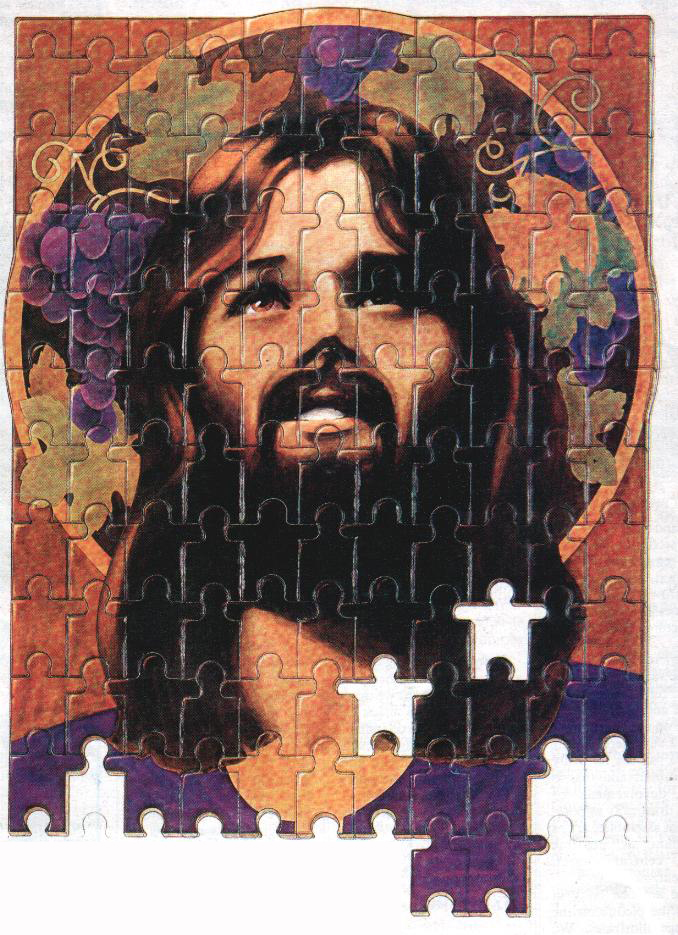
Simply Organic: Who are We?

Words, names and stereotyped expressions can deafen us to the voices of the things themselves, so that for the deaf the things have died – a personal and original relationship with them has become impossible. One can’t tell a thing to a person who knows the words, he is no longer receptive. Gerrit Kouwenaar

I have been thinking about this word “organic” lately. Some of us are planning a “Simply Organic” conference here in Bloemfontein for early 2013, and so the term has been on my mind more than usual.

It’s a nice word, I must admit. It works well. And that is where the problem is.

One of the cars that are most popular with hijackers in South Africa (our hijacking statistics have gone through the roof ages ago) is the Nissan 1400 “bakkie”, as it is called here.

The reason? It works unbelievably well. It does what it is supposed to do. It is simple, strong, cheap and reliable. It is popular. And so hijackers love it.

The same has happened to the term “organic”. It’s being wordjacked. It’s such a lekker word that everyone wants it, even those who haven’t paid the price for it. And so it is being grabbed and claimed all over. The result is that a very good word has now become somewhat overused and murky.

The name has taken the place of the thing itself, as oftentimes happens with descriptive words. To make matters worse, its meaning has become associated with some of its new owners, rather than with its own and original definition.

For a true understanding of a clichéd descriptive word, such as “organic”, two things are needed: Firstly, we need to rid ourselves of those things that block our perceptions to the real. We need to weed out the unfortunate associations that have taken our thoughts captive and blinded us. Secondly, we need to revisit the original word to ensure that we understand its own meaning.

The next few posts will be mainly concerned with the first exercise. It is a weeding experiment, and it is mostly birthed from a number of recent observations that have stirred up that old feeling of being invaded (some would say molested) so reminiscent of the type of Christianity that wants to turn someone else’s private and subjective experience (and interpretations) into doctrines and norms for the rest of us.

I don’t mind you walking on my holy ground, but please leave your shoes outside. They fit you and they have walked your journey. Bring yourself in here. That’s ok. But don’t impose your walk on me.

With that sorted out, let’s talk about those things that many of us are not, and that we will never be, even though we proudly associate ourselves with being “organic”. I will deal with them one by one in the next few posts.

Please note that these are not astute scholarly observations, but knee jerk responses from those of us whose desire it is to preserve our freedom in Christ. If you don’t agree with the list, just imagine that the heading reads “Simply Organic: Who are Some of Us?”

1. We are Not a Resistance Movement

Need I say more? We are not “against” or “anti”. We are “for”. To use another overused and now clichéd term: We are not reactive, we are pro-active.

Don’t take this for granted. Are you a Protestant? The moment you say “yes”, you have distinguished yourself as being “against” instead of “for.” You are a protester. That’s what your name means and that’s how subtle this whole business is. Your reason for being is derived from the fact that you are protesting against… uhm, what was it again?

Truth is, most Protestants cannot complete this sentence. If you are one of them, dust off that church history book and turn to October 1517. Then you’ll find out what your problem is, or rather who you have it with. And then you may also wonder what you will become once the problem is no longer around. (Or what you have already become, seeing that you have forgotten about your problem.)

That is the tricky thing with all resistance movements. The accomplishment of their goals signifies their demise, and so they usually need a new enemy to sustain their levels of commitment.

This is why our fervor may never arise from our anger or disgust with the religious establishment, or “institution”, or “system”, or whatever we may wish to call it. Too many organic folk feel a sense of camaraderie because they relate with one another’s hurts and the ecclesiastical abuses of the past.

Beware. Judas was a zealot and the man of perdition’s title begins with “anti” (Is there a hint somewhere in there that offense has been taken?).

We are FOR, not AGAINST.

Of course we resist. Of course we fight. But that is circumstantial to our main calling, namely to inherit a promised land and to be made into a kingdom. We do not allow the fight to get into our bloodstream. We are not mercenaries. We do not feed on the presence of our enemies.

In fact, we are not even angry.

Some of us were, I have to admit. But no more. We are moving on.

And so, for those who are foaming at the mouth because of what the institutional church has done to you: Welcome. But you are going to have to leave your offense outside.

Right there, next to your shoes.

(The next post will deal with the fact that we are not a celebrity cult, which means that no single person or party speaks for the rest of us.)


No Cheating

You study the scriptures, thinking that by them you have life… yet you refuse to come to me to have life. John 5:39-40

There are two ways in which a person can arrive at the answer to a sum: You can get it from someone who already has it (with or without his/her consent) or you can work it out for yourself.

If schoolteachers are to be believed, the latter way is by far the preferable one.

But even here conditions apply. Years ago, way back in primary school, I was awarded one point out of ten for a perfect answer to a quite complicated sum. The teacher disregarded the innovative way in which I had figured the answer out in my head, explaining that I would not be able to do the same with larger numbers. I lost the other nine points because I had ignored the tried and tested formula. I had set myself up to become a maths heretic.

I learned the lesson well in my formative years, but had to unlearn it when I finally graduated into seminary. Here everything was about answers. The sums had already been figured out and we were expected to learn the answers without thinking too much in the process.

The only problem was that another theological school, a mere few blocks away, were teaching their students different answers.

I sometimes wish my mathematics teachers taught me theology. She would have insisted that I became a thinker instead of a parrot. But she would have forbidden me to use my own independent judgment in my thinking. I would have had to think according to very specific rules and within very defined boundaries.

That’s the whole idea. The knowledge of God has been revealed to us in Jesus Christ and is preserved in Scripture and the ongoing teaching of the Holy Spirit within. You cannot have the one without the other. True Christianity is not memorising doctrines or living by laws. It is not to blindly accept the conclusions of another, no matter the brilliance of his/her scholarship or any reputation whatsoever of great understanding or guru-like insight. It is to work it out for yourself: Personally, experientially, uniquely. Yet it is to do so within the clear objective boundaries of Scripture.

If you say “Lord, Lord”, but you don’t know how you got there, you are in for a surprise.

There is nothing as exhilarating as the discovery of truth. It is to find a fine balance in the midst of the mightiest bursts of revelation imaginable. It is big wave surfing in every sense of the term, an encounter with the might and beauty of God, but with a focused concentration and skill that makes the required balance possible. This skill cannot be taught in a classroom, yet the method of obtaining it can. It has to be discovered in a way that will make you feel you are the only one who has discovered it. It is an experience that is wholly unique and original, yet it is one that takes place within very narrow boundaries. It is totally original, yet the scope for innovation is extremely limited. It is your own discovery, yet it can only be discovered according to a method that is so precise that it can be described as a science.

Truth is to know Jesus Christ personally and intimately, but never apart from the clear guidelines presented by Scripture.

Where this happens, the answers will present themselves.

(This article has appeared in abbreviated form in Bloemnews.)

Thinking Soberly

I appeal to you therefore, brothers, by the mercies of God, to present your bodies as a living sacrifice, holy and acceptable to God, which is your spiritual worship. Do not be conformed to this world, but be transformed by the renewal of your mind… For by the grace given to me I say to everyone among you not to think of himself more highly than he ought to think, but to think with sober judgment, each according to the measure of faith that God has assigned. For as in one body we have many members, and the members do not all have the same function, so we, though many, are one body in Christ, and individually members one of another. Having gifts that differ according to the grace given to us, let us use them… Romans 12:1-6

A living sacrifice is something that has died, yet it is alive.

Paul’s comment in Romans 12 is the logical conclusion of his teaching in chapter 6 of the same letter: Christ died and was resurrected, and we died with him and were raised with him. We are to “reckon ourselves dead unto sin and alive unto God” (Romans 6:11.)

We are to think of ourselves as living sacrifices, in other words.

This is what the “renewal of the mind” is all about. We need to align our minds with the historical reality of our co-death and resurrection with Jesus Christ. If we do so, our lives will be transformed accordingly.

But Paul does not stop there. This new type of thinking is further elaborated on in verse 3. We many no longer think “higher of ourselves than we ought to.” The illusions of grandeur that were entertained by the old self are no longer allowed. We are now to think of ourselves “according to the measure of faith that God has assigned” to us. This measure is determined by our membership in our new family, that is, the body of Christ.

Our calling in life is not to live up to some projected image of the idealized self. Neither is it to try and eradicate the self in order to become nothing.

No, it is to understand the measure and calling of the new resurrected self, as it fits into the body of Christ, and to live according thereto.

Do Unto Others

So in everything, do to others what you would have them do to you, for this sums up the Law and the Prophets. Matthew 7:12

The Bible is a very thick book. With the help of some of us, it has also become a very complicated one.

God may be mysterious, but he is not complicated. His revelation to us has always been simple. There was nothing complicated about Jesus Christ, his life or his teaching. Paul wrote to the Corinthians “For we do not write you anything you cannot read or understand.”

The Old Testament, commonly referred to as “the Law and the Prophets”, can be summarized in a single sentence. That is how understandable God has made it.

Every single one of my children came into the world knowing exactly what they wanted. Every person I have ever met in my life knew what he or she wanted from others. Inscribed upon human nature is a script that cannot be erased: “This is what I want.”

The central message of the Bible is remarkably simple. It does not prescribe an ascendance of consciousness that will take the participant from one mystical illumination to the next. It does not prescribe decades of academic research to discover the evasive thoughts of God.

No. It takes that which is most clear to every person on the planet and uses it as a script for our lives. It takes the “This is what I want!” and prescribes it as the basis for our actions towards others.

Inside of us are the Law and Prophets of God. We cannot shake them. They are revealed perfectly. The problem has never been with the “What?” It has always been with the “Who?”

You know full well what a human being needs. Now go and provide it.

Rethinking the Great Commission

Therefore go and make disciples of all nations, baptising them in the name of the Father and of the Son and of the Holy Spirit, and teaching them to obey everything I have commanded you. Matthew 28:19-20

Apart from John 3:16, the “Great Commission” may very well be the best-known and most quoted verse in the Bible. Yet it contains a startling implication that we oftentimes miss when we read it, speak about it or try and obey it.

Note that the calling is to make disciples, not converts. Also note that the way to do this is to teach them “to obey everything I have commanded you.”

Some of us stop reading when we see the word “nations”.

If you are a tent evangelist up in Africa and your fiery sermons and passionate altar calls make thousands stream to the front to say the Sinner’s Prayer and “give their hearts to Jesus”, you are doing a mighty fine job. But you are not fulfilling the Great Commission.

Others stop reading when they see the word “teaching”.

If you are a Bible teacher and you devote your life to expounding the Scriptures and teaching the great doctrines of the Christian faith to people, you should be applauded. But you are not fulfilling the Great Commission.

Note again: The great Commission is about “teaching them to obey everything I have commanded you”, not “lead them to me” or “clarify my teachings to them”.

Jesus Christ is more intelligible than any one of his commentators. His teachings and commandments are crystal clear and extremely simple. The difficulty has never been to understand Jesus. It is to obey him.

We are to go into the world and assist people to obey commandments that are stated in the plainest language imaginable. That’s the Great Commission.

Stephen Crosby’s “The Offense of Radical Grace”

This post ministered to me in an unbelievable way. Yes, I admit it. The Pharisee within has oftentimes been deeply offended by the way in which God chooses to use people whom I would never have used (I would always use me, of course). I’m also offended that I didn’t write this.

The Offense of Radical Grace by Stephen Crosby

God uses very flawed, damaged, and “imperfect” people to accomplish great things for His kingdom interests. After all, damaged, imperfect, and flawed people are all He has to work with to begin with, including you and I! The expansion of His kingdom is not held hostage to the development of our character. Faith works by love, not by holiness and this is offensive to all spiritual over-achievers.

Some say this makes grace a license to sin. God forbid. However, this truth of radical grace is very offensive to religious sensibilities of propriety: how unholy people can be used to accomplish dynamic, holy results. It is, never the less, the way it is. Does this mean we do not deal with sin issues? God forbid. Does this mean that our transformation into the image of Christ is of no value? GOD FORBID! Transformation is EVERYTHING that matters to us subjectively and for all eternity!

HOWEVER . . . .

it also does not mean that in order to go forward in and through human vessels, OBJECTIVELY FOR THE BENEFIT OF OTHERS, that God’s kingdom requires a preconceived notion of some level of personal holiness (Begs the question . . . How holy do you have to be, and who measures it?)

Yes, this is the offense, the risk, and the contradiction of putting His Holy Spirit in clay vessels. It pricks and irritates the little Pharisee hiding in each of us. It irks that carnal religious desire for “fairness” and “equity.” We often have a language of grace on our lips, but in the deepest recesses of our soul, we still live and think out of a merit-based system. We operate under a contractual understanding with the Almighty, rather than covenantally from a revelation of His love.

It is deeply offensive to our religious sensibilities to see someone who in thinking, doctrine, and behavior, is in error, sin, immaturity, or gross misbehavior, experience LEGITIMATE kingdom fruit in greater degree and measure than ourselves and the people we associate with. “God . . . how can so and so be so used by you?” “I mean they are______. (Fill in the blank with the egregious shortcoming of your choice)

It bugs us.

When that question comes out of our consciousness, it proves we still do not understand the grace of God. The obvious question to ask in response is “How can God use you?”

Do you really think your acquisition of personal holiness merits His special favor? The Lord is LORD of His own! He can do what He wants, how He wants, when He wants, with His own. Before Him, and Him alone, will each of us stand. How the LORD of the harvest uses other broken sheaves in His field, is none of our business.

What then of obedience? What value is there then to obeying? It breaks my heart to even hear that kind of thinking come out of believers’ mouths. It reveals such a meager understanding of the gospel.

Jesus is His own reward. Obedience is the logical fruit of the new nature, the logical return on the investment of the life of the Son of God in us. It is the reasonable expectation of the husbandman on the seed of the Son that has been planted in us by and in the Person of the Holy Spirit.

I don’t obey because of some sort of quid-pro-quo negotiated benefit contract with the Almighty! I obey because obedience is His gift in me, He is worthy of it, and most of all . . . because I love Him! Why would I not want to obey? Fish are created to swim, birds are born to fly, and horses are born to run. Obedience is the supernaturally natural response of the new creation nature! It is HIS LIFE in me, released through the power of an endless life, via the cross daily taken, in cycles of death and resurrection to my soul . . . all the days of my life. We are born to it . . . if we are really born . . . if we are really participators int eh new creation life . . . and the longer I live the more I agree with Dr. D. J. Kennedy who said before he passed that it was his conviction that 75% of the people in evangelical churches are not born again/converted. I think he may have been an optimist.

Obedience is its own reward. Our “reward” (If we must use that language) is not necessarily harvested in this life. Eternity is not a commune with everyone in a white robe and a halo sitting on a cloud and strumming a harp and singing praise songs forever! We will be occupied in eternity with unspeakably glorious co-regency privileges of mature, overcoming sons and daughters like unto the First-born . . . things so glorious that like Paul, I can’t share them with you here. But what we do with Christ, the gift of God . . . how we live . . . in this life . . . matters. It determines eternity.

I often wonder if the people who ask that question (“Well, if grace is so radical as you say, what’s the point of obeying?) have ever really met the Lord? I can’t help but think they haven’t, or at least not the Savior I know and love. They may have been introduced to some system of religious beliefs and behavior modification based on the Bible, but I have doubts about their encounter with a resurrected, God-Man in glory, the ever living Son of God and Son of Man who is the lover and redeemer of their souls, who has united His Spirit with theirs, who has taken up residence in them, and who will be in them forever . . . .

Joy unspeakable . . . and full of glory . . .

Copyright 2012, Dr. Stephen R. Crosby, http://www.swordofthekingdom.com. Permission is granted to copy, forward, or distribute this article for non-commercial use only, as long as this copyright byline, in totality, is maintained in all duplications, copies, and link references. For reprint permission for any commercial use, in any form of media, please contact stephcros9@aol.com.

Beholding Christ

And we all, with unveiled face, beholding the glory of the Lord, are being transformed into the same image from one degree of glory to another. 2 Corinthians 3:18

The first humans were created in “the image and likeness” of God. This image was marred as a result of the fall, but is under construction yet again due to the fact that we are new creations in Christ Jesus.

The New Testament and the Old Testament are perfectly correlated as far as our reason for being is concerned. From the beginning God’s purpose for you and I was to exist in the image of God.

But there is a catch. In order to be transformed into this image, we need to “behold” it first. The word is not one we use in everyday English, but can be roughly translated as “looking with intent”.

Why? Sociologists and anthropologists may provide the answer. The process of human growth and maturation is dependent on an intricate process of identification with a “role model”, they tell us. This may be confirmed by the fascinating studies that have been done on so-called “feral children”, that is, children whose primary caretakers, during their formative years, were animals.

Feral children take on the characteristics of the animals that raised them. They typically walk on all fours, have short lifespans, develop many of the same sensitivities and oftentimes suffer from telltale growth deformities.

We become like our role models. We become like those we look up to. We identify with them and in the process trigger a magical transference of qualities that are characteristic to them.

It is the same spiritually. We become what we behold. The most important song on planet earth may very well be the classic Irish hymn: “Be thou my vision…”

Who, or what, are you beholding?

One Bread Many pieces: A Question and Response

Some time ago our brother Dylan down in Cape Town (I know, he is a blessed man) commented on the One Bread Many Pieces post. Dylan asked an important question which prompted quite a lengthy response from me.

The issue is close to my heart, and so I post my response here for those who may have missed it. I quote from Dylan’s comment:

“Once moving out of institutional church there is a level of haziness with regards to oneness. Especially because there are so many different groups meeting outside the institutional church, but all in different ways. Before, in the institution, there is oneness in a way of doing church. But now, outside, there are also different ways – they just don’t have a brand name and bank account attached to them. Our desire is not to be fixated on a way but on Christ alone, and to have unity in Him with every believer. But is this realistic? And is it biblical? I do not know. Up until now, it is the one area of theology that we are all struggling with. I would very much appreciate your thoughts on this.”

Here follows a part of my response:

As far as the New Testament view on church unity is concerned: Paul links the unity of the body with the “knowledge of the Son” in Ephesians 4: “…so that the body of Christ may be built up until we all reach unity in the faith and in the knowledge of the Son of God and become mature, attaining to the whole measure of the fullness of Christ.”

There are a few things to notice here. Firstly, the “building up of the body” is a process during which the church has not yet attained to the “unity in the faith”. This work of “building up”, together with the temporary offices necessary for it (as described in the previous verses) will continue “until” this goal has been reached.

By implication, the church being “built up” is marked by two primary characteristics that necessitates the work of “building up”, and without which spiritual maturity according to the “whole measure of the fullness of Christ” has not yet been reached: Disunity and an insufficient knowledge of the Son of God.

At the heart of all ministry we find these two ultimate aims, and the link between them makes perfect sense once you begin to think about it. The well known division in the Corinthian church (“I follow Paul”, “I follow Cephas”, etc.) was due to the Corinthians being “infants in Christ” (1 Cor 3:1). Paul says they were “being merely human” (v4) by following men.

It would appear that spiritual immaturity manifests itself in one primary way, namely division.

Why? Because people who are spiritually immature need “milk, not solid food” (v2). The difference between the two is that the one is a predigested form of the other, that is, it necessitates some spiritual mediator who can digest the food on behalf of the immature recipient. And so immature Christians are dependent on following some or other person for their spiritual well being as they cannot feed on Christ himself.

In the words of the Hebrews author, “everyone who lives on milk is unskilled in the word of righteousness” (6:13) and in need of “someone to teach you again” rather than being “teachers” themselves (6:12).

The problem is that this inherent need of someone “to teach me” malfunctions when it comes to identifying a teacher, for the Adamic nature (whose mindset pretty much still dominates the infant in Christ) favours one who reflects his/her own sentiments. And so choosing a teacher becomes like choosing a rock star. The musical tastes in my house serve as a metaphor, ranging from Opera to Rap to Kurt Darren to Dan Patlansky to Flogging Molly to Pink Floyd to Teletubbies (amongst our nine kids there is a 3 year old). Furthermore, the younger the kids the harder to predict what they will get into next month (We had a High School Musical wave some time ago but it was replaced with the music from the Twilight Saga which is now also becoming old news).

All of this is strangely reminiscent of the statement Paul makes to the Ephesians to further clarify the “mature manhood” characterised by the “unity of the faith” and “the knowledge of the Son of God”: “Then we will no longer be infants, tossed back and forth by the waves, and blown here and there by every wind of teaching and by the cunning and craftiness of men in their deceitful scheming. Instead, speaking the truth in love, we will in all things grow up into him who is the Head, that is, Christ…” (4:14-15).

What this means is that disunity has a purpose. It reveals the degree to which people has not come into a direct, unmediated knowledge of the Son of God, which happens to be the essence of spiritual maturity. This may very well be what Paul had in mind with his later statement to the Corinthians: “… for there must be factions among you in order that those who are genuine may be recognised” (11:19). Ouch.

The link between spiritual maturity and knowing Chris is confirmed in Philippians 3. Here we read that Paul has counted his Pharisaical past as “dung” for the sake of one pursuit only: “I want to know Christ and the power of his resurrection and the fellowship of sharing in his sufferings, becoming like him in his death, that by any means possible I may attain to the resurrection from the dead…” (v10). This knowledge of Christ, culminating in the resurrection, is revealed in the next verses as the goal behind Paul’s “forgetting what lies behind and straining forward to what lies ahead” (v13), and his striking, conditional conclusion: “Let all of us who are mature think this way…” (v15).

The bottom line? Mature people understand that the ultimate goal is to know Christ and to forsake the teachings and traditions of men as ends in and of themselves. They are the ones who “glory in Christ Jesus and put no confidence in the flesh” (v3). They understand that Christ is not divided (1 Cor 1:13) and that he alone is the source of our life in Christ Jesus (2:30). They have learned to feed on Jesus Christ, and they derive their life from him alone.

There are several practical implications to the above:

Firstly, unity amongst the brothers and sisters is a quality of their unity with Christ. Without the latter they cannot have the former. Unity is a flower, never a root. It reveals the true nature of what is within.

Secondly, division is the inevitable manifestation where the ego still dominates. The pursuit of self is always at the expense of relationships. Genesis 11 teaches us that our vision, our name, our building, our ability to build bricks, even our oneness… will result in one thing only: A God ordained division.

Thirdly, the growth of the church in this world is a growth from infancy to maturity, from division in the faith to unity, from following men to knowing Christ, from denominating ourselves from other believers to “receiving one another as Christ also received us” (Rom. 15:7) and from using names of people as a badge to distinguish ourselves from other believers to simply being the church in any given locality.

Fourthly, the “unity of the faith” is not an idealistic dream. It is a very definite destination and we will get there, according to Paul. The question is not “if” but “when”. It is interesting to note that Jesus also refers to this in his prayer that refers to both “knowing Christ” (John 17:3) and the unity of the church: “…I have given them the glory that you gave me, that they may be one as we are one: I in them and you in me. May they be brought to complete unity to let the world know that you sent me and have loved them even as you have loved me.”

Lastly, none of this detracts from our responsibility to make every effort to be one in a practical and visible manner in the here and now. This is clear from Paul’s rebuke to the Corinthians as well as his statement in Ephesians 4: 3-6: “Make every effort to keep the unity of the Spirit through the bond of peace. There is one body and one Spirit—just as you were called to one hope when you were called— one Lord, one faith, one baptism; one God and Father of all, who is over all and through all and in all.” The oneness of the body is the logical and inescapable conclusion of the unity that exists in the Godhead.

And so, while we are awaiting the maturity of the body and the answer to Christ’s prayer, we are obligated to express unity as far as is possible. This means that churches who agree with the basic thesis as set out above are under an obligation to function as one body, even though they may meet in different localities.

One way to do this, I believe, is to adopt the naming convention I referred to in The Glorious Church post a few weeks ago. Another is to meet & eat together if and where possible. Another is to minister at one another’s fellowships. And so I can go on.

There is so much more to be said than this, and I have already been too longwinded. But let me close with a last observation. I am not sure I agree with any prescription as to how a church must be “planted”. No matter how much a group of brothers and sisters love the Lord and wish to express their unity with other churches, the moment that their “church” can only be officially established though the intervention of a certain “church planter” or “apostle” the human element enters into it and the subtlety of the “I follow…” attitude resurfaces. I am seeing this amongst Godly people who will shout “Amen” to everything written above. They heartily agree, but they differ on who is an actual church planter who is qualified to officially “plant” churches. And it is causing the same old division under a different guise.

Jesus Junk

Making a whip of cords, he drove them out of the temple… And he told the pigeon-sellers, “Take these things away; do not make my Father’s house a house of trade.” John 2:14-16

USA Today reported in 2009 that American retailers “sell about $4.6 billion worth of Christian products annually.”

One cannot help but wonder how big that figure is today and how big it would be if the rest of the globe were included in the statistics.

According to the report, you can now wear a “Jesus Christ wants to be your friend” Facebook shirt and an “iPray” hat while listening to your iPod. Preachers can buy material for sermons based on the popular television reality series “Survivor”.

That’s only the tip of the iceberg. Christian merchandise include dolls, jewelry, stationary and a host of items sporting designs that are oftentimes trademark rip offs of well known brands like Coca-Cola (“Jesus Christ—Eternally Refreshing”).

Other designs are totally original, like the one that has Jesus dressed as a hockey goalie accompanied by the words “Jesus Saves!” And then there is the rubber Jesus duck for your bathtub, and the “Wash away my sins bubble bath” to accompany it.

I still have my three-decades-old coffee mug with St Francis’ Peace Prayer on it. And I have joyful memories of buying my first Christian bumper stickers shortly after my conversion. But I think we have lost it somewhere between the Jesus revolution of the early seventies and today. The new vision of a culturally relevant Messiah, expressed joyfully and colorfully by Hippies who had become “Jesus People”, appears to have become a corrupt money-making machine.

In fact, I am quite convinced that we would see a repetition of the events described by John above if Jesus were to return today.

Preparing for Glory

Do you not know that in a race all the runners run, but only one gets the prize? So run that you may obtain it. Everyone who competes in the games goes into strict training. They do it to get a crown that will not last; but we do it to get a crown that will last forever. Therefore I do not run like a man running aimlessly; I do not fight like a man beating the air. No, I beat my body and make it my slave so that after I have preached to others, I myself will not be disqualified for the prize. 1 Corinthians 9:24 – 27

This week the words “hope and glory” flashed across my television screen. I was not watching a religious show, but a broadcast of the 2012 Olympics. Above the words was the face of a man in rapturous ecstasy. He had just won a gold medal.

I know the feeling. I experienced it for the first time after having won a yo-yo competition in the mid seventies. I was a mere kid, and that night I went to bed feeling intoxicated. The feeling could best be described as a mixture of bliss and immortality.

But it did not last. And so I had to follow it up with other victories. When victory evaded me I learned to resurrect the feeling by siding with others who were winning, such as a boxer or rugby team. The stadium atmosphere in the face of victory was equally glorious – an experience of joyful communion and collective invincibility.

It took me years to realize that these feelings were religious ones. Like a prophetic dream, they revealed a deep longing within to fight and conquer the enemy, to finish a race, to receive a “crown” (literally a “prize of honour in the public games”).

At the end of his life, Paul used these words again, this time with hindsight: “I have fought the good fight, I have finished the race, I have kept the faith. Now there is in store for me the crown of righteousness, which the Lord, the righteous Judge, will award to me on that day—and not only to me, but also to all who have longed for his appearing” (2 Timothy 4:7).

In the final analysis, the Olympic Games presents us with a parable that can only be decoded in Jesus Christ, and with a startling contrast between the shadow and the real. As Paul said above: “They do it to get a crown that will not last; but we do it to get a crown that will last forever.”

Strict Training…

The verses above are important as they present one of the clearest contrasts in Scripture between true and false glory (See related posts here and here). Also, they explain why human beings are so obsessed with winning. In the absence of God we try and satisfy the demands of our spiritual instincts by fabricating lookalikes of the divine.

The greatest of human instincts, such as desire and love and fear, are manifestations of our yearning for God. Idolatry is not nearly as crude a thing as we have been led to believe. No, human beings are usually most idolatrous when most sophisticated. The act of substituting God with self is what human history is all about, and we have become extremely good at it.

It is this single-minded focus that Paul addresses in the passage above. If we miss this, we miss Paul’s central point. Whilst the passage in 1 Corinthians 9 presents a striking contrast between two types of running and fighting, and also between two “crowns”, the most important contrast drawn by Paul is between two types of preparation: “Everyone who competes in the games goes into strict training… They do it to… but we do it to.”

It is not only the nature of the competition or the ceremony afterwards that is different in Paul’s analogy. It is the life before. The Christian fights a different enemy, runs a different race, has a different goal, experiences a different hope and anticipates a different glory. As a result, the Christian has a different training program. This is Paul’s point.

What does this program look like? “I beat my body and make it my slave”, Paul says. I subject my human appetites, desires and needs to the heavenly calling.

There is much to be said about this, and I do not wish to do so with this post. The best commentary on these verses, in my view, comes from Watchman Nee. If you are not familiar with his book The Character of God’s Workman, and especially with the section that deals with this issue (chapter 3), I would advice you strongly to read it. Simply click here for chapter 3.

Blessings to all fellow runners and fighters.

(This post appeared in abbreviated form in Bloemnews.)