A Cleansed Conscience

Let us draw near with a true heart in full assurance of faith, having our hearts sprinkled from an evil conscience, and our bodies washed with pure water. Hebrews 10:22

The immediate effect of the primordial sin committed by our great ancestors is described as follows in the book of Genesis: “Then the eyes of both of them were opened, and they realised they were naked…”

The Lutheran martyr Dietrich Bonhoeffer once commented on this passage and described Adam and Eve’s experience as one of “shame”, namely that which gives “reluctant witness to its own fallen state.”

Indeed. Shame is inextricably linked to sin. If we are born into this world as sinners, as the Scriptures teach us, then we also bring with us a very real sense of guilt and shame. The problem of humanity’s struggle with feelings of guilt has been recognized by scholars from backgrounds as diverse as Soren Kierkegaard and Sigmund Freud’s. The problem cannot be denied. It is the solution that is more difficult to find.

According to the New Testament authors, the problem of guilt has been dealt with by the blood of the cross, and by the blood alone. Our legal, objective guilt has been atoned for, and as a result our subjective and experiential guilt is removed. A clean conscience is therefore the logical conclusion of our right standing with God.

Oftentimes Christians fail to understand this, and as a result they fail to draw a distinction between the conviction of the Holy Spirit and the condemnation of the enemy. They may even think there is something noble about their feelings of guilt, as though they are helping to pay for their sins.

Such an attitude defies the righteousness granted by God. As Watchman Nee once said: Let us side with God and not with the accuser of the brethren.

I Follow Paul

Be followers of me, as I also am of Christ. 1 Corinthians 11:1

In the first chapter of 1 Corinthians, Paul rebukes the Christians at Corinth for having said “I follow Paul.” Yet, in chapter 11 of the same letter, he commands them: “Be followers of me.” Is he contradicting himself?

Not at all. It is clear from chapter 1 that the church in Corinth was divided into a number of factions, the reason being that people strongly identified themselves with the teachings of certain individuals. And so they were saying “I follow Paul,” “I follow Apollos,” and “I follow Cephas.” Paul sets the record straight by asking “Is Christ divided?” (1:13).

The message is clear: The gospel cannot be reduced to the teaching of one dynamic individual, group or denomination. This leads to religious pride and elitism. In the end it leads to full-blown sectarianism. Celebrity ministers and cult followings are anathema in the church of Jesus Christ.

The verse above does not contradict Paul’s remarks, but confirms them. Note the defining words “as I also am of Christ”. The apostle is simply saying: “You may follow me, but only insofar as I am following Christ.” Put differently: “Imitate me in the sense that I do not imitate anyone except Christ.” This is just another way of saying “Don’t even think of following me or any other human being.”

This idea does not come from Paul but from Jesus Christ himself. The key sentence of his ministry was “Follow me.” And, of course, he said things like “Neither be called instructors, for you have one instructor, the Christ” (Matthew 23:8, 10).

Jesus never saved us to become followers of other human beings. He saved us for himself. Let us keep it this way.

On Big Picture Thinking

As some of you know, I make a living by drawing funny little creatures. I started drawing cartoons in my first school year and have never stopped. I also have a keen interest in mnemonics, and so at some stage these two passions converged and became the “Bigpicture” concept. If you are interested, you can visit my Bigpicture Website here and, in the process, check out the Gallery.

Big Picture Thinking, or “Gestalt Theory”, is a fascinating but mostly misunderstood phenomenon. To put it in a nutshell: The Gestalt principle is really nothing but a very obvious display of humanity’s yearning for God. We are forever looking for the whole, the context, the pattern, the paradigm, the structure that binds the detail together. And so parts have this tendency to form clusters which make up bigger clusters which make up bigger clusters… Guess where it all ends.

I’ll blog about this again in the future. There is much more to Big Picture Thinking than meets the eye!

The Cult of Selfism

But mark this: There will be terrible times in the last days. People will be lovers of themselves, lovers of money, boastful, proud… having a form of godliness but denying its power. 2 Timothy 3:1-4

I recently came across an interesting quote by Oswald Chambers, the author of the Christian classic My Utmost for His Highest. He writes: “Self-realisation is anti-Christian. All this is vigorous paganism, it is not Christianity. Jesus Christ’s attitude is always that of anti-self-realisation. His purpose is not the development of man at all; His purpose is to make man exactly like Himself, and the characteristic of the Son of God is not self-realisation but self-expenditure.”

Chambers, who passed away in 1917, never lived to see the prophetic significance of his words. He never lived to see a day when Christian bookshops would be stocked with books telling Christians how to maximize their potential, how to make God’s dream for them come true, how to claim their miracles, how to prosper financially, and so on.

It seems that a large segment of the church has succumbed to the philosophy of the motivational revolution, and, in the process, to the spirit of the age. The motivational paradigm has changed the way we think about ourselves, our work and our destiny. To quote Paul Vitz, who have written extensively on what he calls The Cult of Self-Worship: “All the major theories of motivation and personality assume that reward for the self is the only functional ethical principle.” Certain Christians appear to have embraced this way of thinking, and in the process have become devoted to what Vitz calls “selfism”.

Perhaps it is time to heed Chambers’ prophetic wisdom and reassess much of what we have been teaching lately in the name of Christ.

On Spectacles and Other Embarrasments

And when he had disarmed the rulers and the authorities, he made a public spectacle of them, triumphing over them in the cross. Colossians 2:15

Spectacles have an origin. They don’t occur in and of themselves. They are fruits and manifestations of much more primary occurrences. If we hold to the belief that our lives in this world are but shadows of the occurrences that take place in the spiritual realm, which we do, then it should come as no surprise that the spectacles in our lives are mere reflections of an ancient and eternal truth that has been told through the story of the serpent’s rise and fall.

Herein is the key. The rise preceded the fall. The rise was not ordained by God, but fueled by pride, and so it led to the fall – as promotions of the self always do. In its final conclusion, the rise became nothing but a public spectacle, a convulsion of sorts.

It was Paul who noted that the narrative was more than mere history. An overseer of the church, he noted, must not be a new convert, lest he becomes swelled up with pride and fall into the judgment of the Devil. The story is a parable and the message is clear: The one who promotes him or herself will become a spectacle for the world to see. Their rise will not lead to glory but to shame. John tells us in his revelation that the dragon was thrown down to earth. Knowing that his time was short he persecuted the woman. He wished the same spectacle on her that he had become, and so he has tempted her since she first set foot on the planet with the very temptation that he himself had been tempted with, desiring to involve as many as possible in the spectacle that he had become. The first woman became the first victim. Her yearning for greatness led to shame. Both she and her husband were made spectacles as a result of their desire to rise up and be like God, and after them a multitude followed in their footsteps.

It was Jesus Christ, the second man, who reversed the order. His fall preceded his rise. He became nothing, we read in Paul’s letter to the Philippians. Unlike Satan, Adam, Eve and every lost soul in the history of the universe, Christ did not see equality with God something to be grasped. He became nothing, and so God exalted him to the highest place. And herein we are given a second parable, and so since the dawn of time the people of God have been characterized by the fact that they are first a spectacle and then exalted.

It’s Dark Down Here

Christopher Hitchens is facing death. The famous atheist recently lost his voice in his battle with esophageal cancer, and it appears that he will not be with us for much longer. Yet he remains steadfast in his atheistic convictions. He recently wrote to some of his fellow atheists: “Our weapons are the ironic mind against the literal; the open mind against the credulous; the courageous pursuit of truth against the fearful and abject forces who would set limits to investigation (and who stupidly claim that we already have all the truth we need).” The letter was also posted on The Richard Dawkins Foundation website.

Reading the above, I could not help but be reminded of an insight that came to me some months ago, inspired by the much publicised rescue of the trapped Chilean miners at the time. I wrote a newspaper column about it, which I gladly post:

The true light, which enlightens everyone, was coming into the world… He came to his own, and his own people did not receive him. John 1:9-11

The rescue effort of the trapped Chile miners glued the world to their television screens this week. One could almost hear a global sigh of relief with each spectacled miner emerging from underground.

As I watched the footage in the comfort of a living room filled with natural light and lots of oxygen, and with a view of a garden and blue sky outside, my mind drifted. There was a world of difference between my environment and the one these men had been confined in. Yet, after only 69 days, they had adapted themselves to their strange surroundings in a remarkable way. Their eyes had become accustomed to the absence of light, hence the sunglasses. They had settled in an odd routine with a variety of diversions to keep them busy and sane, and so they were scheduled for therapy to ensure a safe reunion with people who knew nothing about living in darkness.

And then I wondered: What if their wives were with them and children were born and raised down there? And what if those children eventually had children? How long would it take for any memory of blue skies and green forests to vanish completely, and for such references to be dismissed as “pie in the sky”? (You can’t prove it, so it cannot exist!).

And what would they do to a stranger who claimed to have been sent from above to save them out of the darkness, especially if he instructed them to leave their old lives and everything associated with it behind as the way of escape was extremely narrow?

They would label him insane. And so they did.

Mistakes were Made

The heart is deceitful above all things, and desperately sick. Jeremiah 17:9

Everybody else but me; everybody else but me
He was talking to those people back in Galilee
Anybody else but me
– Don Francisco

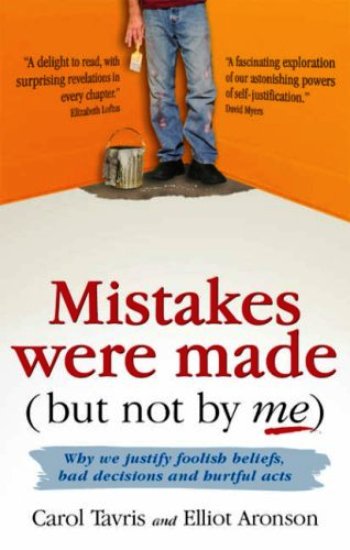
The most frightening book that I have ever come across in my life is not one that comes from the pen of Stephen King, Dean Koontz or any one of the many horror writers who earn their living by scaring people out of their wits. No, it is a book with the seemingly boring title Mistakes were Made (but not by me).

Written by social psychologists Carol Tavris and Elliot Aronson, the book is a fascinating study of the way in which human beings refuse to accept information that conflicts with their dearly held beliefs. Conflicting information causes ‘cognitive dissonance’, and the way in which the human brain reduces this mental discomfort is to create blind spots that blocks out the information that causes the dissonance. And so, Tavris and Aronson tell us, we end up deceiving ourselves in order to sustain our mental equilibrium.

This explains why we are attracted to information that confirms our own biases, why we love to play the blame game and why our memories are so highly selective. It also explains why a number of American presidents referred to their own massive blunders by saying ‘mistakes were made’, as though the mistakes made themselves.

The scary thing about the book is that it exposes the reader to the dark mechanisms at work in his (or her) own heart and mind, revealing how wrong we are when we think we are not quite as wrong as others.

I heartily recommend this book to all believers, especially to my fellow recovering Pharisees.

The Death of Dualism

“Dere be two sides to de gospel,” said the old Negro preacher, “de beliebing side, and de behabing side.”

He was right: The gospel has a God side as well as a human side to it. And in case you hadn’t noticed, it is this very fact that has led to theologians wanting to throttle each other for centuries. Was Jesus God or man? Are we saved by divine election or by free choice? What is more important: Grace or works? Or, in the Negro preacher’s words: Beliebing or behabing?

An Age-Old Division

These are but some of the debates, and they all prove an interesting point: Like the ancient Gnostics, we have noticed that there is both a spiritual and a material element to life. But we struggle to work out the relationship between the two. We struggle to understand how they exist together, and, in our efforts to do so, we often embrace the one at the cost of the other.

Diagrammatically, the relationship between the spiritual and the material is oftentimes presented as follows:

According to our diagram, grace represents the spiritual, the higher, the heavenly, the invisible. Nature represents the material or fleshly, the lower, the earthly, the visible. This would put God above the line, and people below the line. The big question is: How do they fit together?

The Gnostics believed that they had found the answer: They reckoned that the lower storey of “nature” was very much like a prison. The spirit or soul of man was being held captive here, and what was needed was some form of “escape”. This escape could only take place by a denial of everything that was “natural” or fleshly. Celibacy, self-castigation and strict dietary rules are some examples of efforts to escape the lower storey of nature.

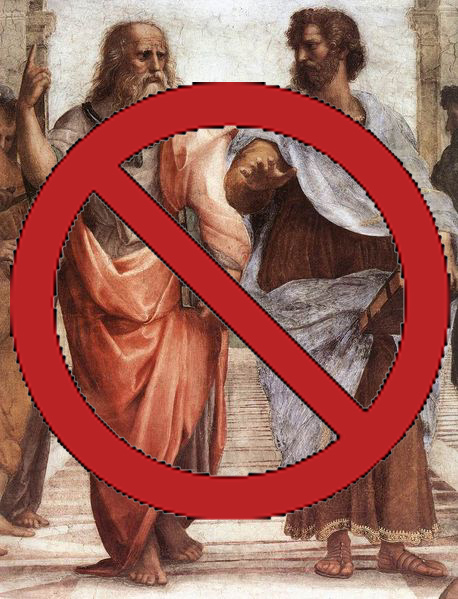
Had Plato lived in the second century, he might have sued the Gnostics for stealing his ideas. Plato was much concerned with the division between the upper and lower levels of life, and so the term “dualism” is narrowly associated with Platonic thought. Raphael’s famous painting The School of Athens is mostly interpreted as presenting the tension between the heavenly and the earthly dimensions: Plato and Aristotle are seen in the center of the picture, with Plato’s finger pointing up and Aristotle’s hand gesturing down. It has often been said that every great Greek philosopher can be seen in the picture. The challenge to understand the relationship between so-called “first causes” and its earthly manifestations was a common one at the time.

The Birth of Christian Dualism

Many years later, these ideas would infiltrate Christianity under the guise of monasticism. It was basically the same old Gnostic idea, heavily influenced by Platonic dualism, with a Christian whitewash over it. It was also a fulfillment of a chilling prophecy that Paul gave to Timothy long before:

Now the Spirit expressly says that in later times some will depart from the faith by devoting themselves to deceitful spirits and teachings of demons, through the insincerity of liars whose consciences are seared, who forbid marriage and require abstinence from foods that God created to be received with thanksgiving by those who believe and know the truth. For everything created by God is good, and nothing is to be rejected if it is received with thanksgiving, for it is made holy by the word of God and prayer. 1 Timothy 4:1-5

Along the same lines, Paul wrote to the Colossians:

Therefore let no one pass judgment on you in questions of food and drink, or with regard to a festival or a new moon or a Sabbath. These are a shadow of the things to come, but the substance belongs to Christ. Let no one disqualify you, insisting on asceticism and worship of angels, going on in detail about visions, puffed up without reason by his sensuous mind, and not holding fast to the Head, from whom the whole body, nourished and knit together through its joints and ligaments, grows with a growth that is from God. If with Christ you died to the elemental spirits of the world, why, as if you were still alive in the world, do you submit to regulations – “Do not handle, Do not taste, Do not touch” (referring to things that all perish as they are used)–according to human precepts and teachings? These have indeed an appearance of wisdom in promoting self-made religion and asceticism and severity to the body, but they are of no value in stopping the indulgence of the flesh. Colossians 16:23

Note that the effort to deny the lower storey of matter, through “severity of the body”, is accompanied by efforts to make manifest the higher spiritual storey, through visions and an obsession with angels.

A Stairway to Heaven

Christian dualism is what you get when you subscribe to a mystical and otherworldly view of spirituality (not in the Barthian but in the Platonic sense). It is rooted in the assumption that our salvation, according to this definition, has come in its fullness and that we can and should live on this planet as super-spiritual beings. Due to the fallenness of our environment, however, we are held prisoners, and thus we dedicate our lives to planning and implementing our escape. This we do by creating various spiritual compartments in our lives that allow us to act out our otherworldliness. We have done so over the centuries, from the early years of Monasticism to that which we call the “full-time ministry” today – the ultimate modern compartment of super-spirituality, and, as such, the object of envy for millions of Christians.

Some of us have crossed the threshold between matter and spirit, between worldliness and divinity, and we live our lives on a different plane.

Dualism and the New Covenant

Of course this is not what the Bible teaches. Christianity is an integrated lifestyle – being in the world, but not of the world. The Old Testament picture of compartmentalised religiosity has been done away with as a result of the dawning of a new, better covenant: A covenant where the Sabbath is no longer restricted to one day of the week, but where it becomes a lifestyle of rest due the finished work of Christ; a lifestyle where the ritual of sacrifice is no longer restricted to certain times and events, but where it becomes a permanent reality in heavenly places; a lifestyle where prayer is no longer something we do only at set times, but something we are admonished to do at all times; a lifestyle where our giving is no longer restricted to one tenth of our income, but to everything we own; a lifestyle where we no longer fast at certain times for certain purposes, but where fasting becomes a lifestyle of continuing sacrifice – where we become the sacrifices, as Paul puts it; a lifestyle were the ministry of the priesthood is no longer limited to a select few, but where each and every believer carries the title of priest; a lifestyle where the art of loving is no longer something we do only where we find those who qualify for our love, such as the image we find of the “neighbor” in the book of Leviticus, but something we do at all times to all people, such as the image we find of the neighbour in the parable of the good Samaritan and the Sermon on the Mount – where we do not look for a neighbour but we become the neighbour – living a life of love, as Paul instructed the Ephesians; and lastly, a lifestyle where we need not break into the holy of holies because our God is hiding there, but one of continuous fellowship with a God who is with us.

Compartmentalised spirituality has become the great enemy of the church, partly due to its extreme form of godliness and the religious pride it injects, and partly due the excuse it offers the rest of the spiritual plebs for just being the unspiritual creatures they are. The one side of the dualistic coin is legalism, the other side is worldliness – and these two have proven to be the greatest barriers to the life preached by Christ.

Dualists are people who do not realise that the call to discipleship is not a call to “doing” but a call to “becoming”. They do not see that God’s restorative action in our lives took place not because he introduced more or better ritual, but because he introduced the concept of the “new creature”, something unheard of in religion. And by introducing this concept the death of ritual was announced, for ritual no longer served any purpose. We now understand that its only purpose was that of a shadow, a symbol, pointing ahead to the good things that were coming.

The Great “There” Promised by Dualism

Dualism fuels the religious rat race, for it offers a pot of gold at the end of the rainbow, a higher state of being, an Archimedean point of absolute spirituality. Of course there is no unanimity as to exactly what this state consists of – the only unanimity amongst dualists being their collective discontentment with ordinary humdrum spirituality, and their subsequent desire and efforts to escape from it. And so we are always on our way somewhere, but we never arrive. We are always on a fast train to nowhere, which is why the trip feels great but the destination not. And whether we are chasing revivals, new waves of teaching, apostolic reformations, or whatever, like astronauts we always find ourselves coming back to earth after a season in space – only to begin planning for the next trip.

To use C.S. Lewis’ quip, “we live in the Shadowlands”, forever searching for that glorious spot of sunlight that so constantly evades us, forever searching for a stairway to heaven. Like the Samaritans, we believe our worship will be possible once we have identified the place to do it, and in the process we have created many mountains and even more Jerusalems. Feverishly active as both travelers and tour guides on these pilgrimages, Jesus’ crystal-clear teaching seems to have completely passed us by: “…a time is coming when you will worship the Father neither on this mountain nor in Jerusalem…a time is coming and has now come when the true worshipers will worship the Father in spirit and truth, for they are the kind of worshipers the Father seeks.”

Spiritual worship is possible worship, for it requires nothing but inner submission to God. It is the only fitting response to Jesus’ unorthodox and earth shattering statement “The kingdom of God is within you”, made to a group of religious separatists who were forever arguing the benefits of tradition, ritual and ceremony. By pointing inward, Jesus once for all settled the debate as to where God’s seat is to be found. An inner kingdom demands an inner response, an inner journey, and an inner kingdom places God within reach of all people. We no longer need to go to the mountain, the mountain has come to us. We are still pilgrims, yes, but our pilgrimage is a spiritual one.

Like the foolish Galatians, we have been bewitched. We who started of with the Spirit have halted in the flesh. Unwilling to accept that there is such a thing as a free meal, we have stubbornly refused to live by manna alone, and instead have slaved away at erecting a golden calf.

What Actually Happened on the Day of Pentecost

As a young Christian, eighteen at the time, I joined a Pentecostal denomination, and it took me nearly another eighteen years to find out what the day of Pentecost was all about. Strange as this may seem, it makes perfect sense when I think about it in hindsight. For many years I had the notion that the Spirit of God was a vague, impersonal, disembodied vapour who did little more than “energise” people. Certainly no-one ever taught me to believe this in so many words, yet this is what I perceived. In retrospect, it is clear that these beliefs came about as a result of the continual “search” for the Spirit that I observed in my denomination – as if He had disappeared. Phrases and prayers like “Come, Holy Spirit”, “I sense the Spirit of God in this place” and “Allow the Spirit to touch you” all contributed to my belief that the Spirit was far away and hard to find, yet that He appeared at times out of the blue, like a distant uncle popping in for a surprise visit.

Many years later I realised that the Spirit of God is not a force, nor an entity apart from God, but in fact God himself. And this changed my perception of Pentecost. Rather than an outpouring of raw power that had to be repeated over and over again, Pentecost became the day that the God of the heavens came to visit, and stayed. God was finally with us. The Spirit was no longer restricted to the holy of holies, but now made his dwelling with men and women. In order to become spiritual worshipers, the Spirit was needed, and it was on this glorious day that the Spirit came. It was not the beginning of a new era of successive visits and outpourings, but the birth of spiritual worship – a continuous relationship with the God who is with us.

And, as you would guess, it was the day that dualism died.
Lessons from a Lost Son

In his classic work The Return of the Prodigal Son Henri Nouwen offers some penetrating insights into the symbolism behind the younger son’s departure. He says: “Leaving home is living as though I do not yet have a home and must look far and wide to find one. It is a denial that I belong to God with every part of my being, that God holds me safe in an eternal embrace, that I am indeed carved in the palms of God’s hands and hidden in their shadows.”

The prodigal son experienced what we would call today an “identity crisis”, a term coined by the sociologist Eric Erikson to describe that period in our teens when we struggle to dissociate ourselves from our parents with the hope of forming a secure identity. This explains the turbulence of those years. We are like strangers in a storm looking for the bridge that will take us to adulthood and safety.

The prodigal tried to solve his particular crisis by dreaming of a “distant country” where he believed he would discover himself. He had not come to terms with the fact that he was the beloved of the father, and that this constituted his identity. Instead, he chose to be defined by the world.

In his book Nouwen draws a striking parallel between the prodigal’s fantasies and the temptations of Christ. Satan offered Christ instant gratification, worldly treasures and the acclaim of the people – a shortcut to self actualisation. Yet Christ resisted these: He had just heard the voice of his Father, saying “You are my Son, whom I love; with you I am well pleased.”

These words tell us who we are and where our true home is. When we are in touch with our sonship, as Christ was, we become immune to the onslaughts of the tempter.

A Love that Fills

As promised…

I bow my knees before the Father… that you may have strength to comprehend… the breadth and length and height and depth, and to know the love of Christ that surpasses knowledge, that you may be filled with all the fullness of God. Ephesians 3:14-19

The “fullness of God” is a subject that has been receiving a lot of airtime lately. Everyone wants to be full of the Lord, it seems.

The problem is that not everyone agrees on how to receive this fullness. Some think they need an evangelist to pray for them during a revival service and shout “Fill!” Others retreat to a quiet place, such as nature, and spend time in deep contemplation before the Lord, waiting to receive the Spirit’s fullness. Others believe that the Lord only fills the obedient, and so they try to live blamelessly. And so on.

Whilst all of the above may be perfectly legitimate expressions of Christian devotion, the Bible portrays the fullness of God differently. According to Paul, a Christian can only be “filled with all the fullness of God” as the result of a profound revelation: The comprehension of “the breadth and length and height and depth” of Christ’s love.

To know this love, Paul says, surpasses knowledge. It cannot be taught in a classroom, studied at a seminary or learned during a clever sermon. The lover does not use messengers. He himself wants to say to the beloved “I love you.” This explains why Paul does not lecture the Ephesians on this topic, but prays to God that he will reveal it to them.

The Bible is a divine love story. The good news is that you are the bride on whom the Bridegroom wants to bestow his love, and herein lies your fullness.